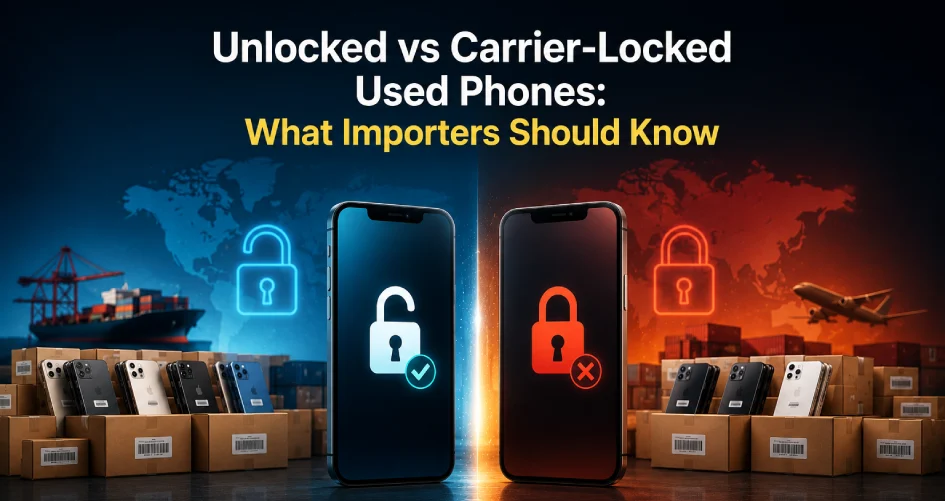
Many overseas importers discover a costly problem only after wholesale used phones arrive: some units are still tied to a carrier network and cannot be activated in the buyer’s target market. This single detail, unlocked vs locked used phones, often decides whether a shipment sells smoothly or sits in a warehouse generating refund requests. Carrier locks are especially common on used iPhones sourced from the US and Japan, where devices are frequently sold through financed carrier contracts. This guide explains how network locks work, why wholesale unlocked phones matter for resale flexibility, and exactly what to verify before confirming any purchase order.
Unlocked vs Carrier-Locked Used Phones: Understanding the Core Difference
An unlocked phone accepts any compatible SIM card, letting the end user connect to whichever network is available in their country. A carrier-locked phone, by contrast, is restricted at the software level to a single original network, and it will reject other SIM cards until that restriction is formally removed. This lock is tied directly to the device’s IMEI number, not to its physical condition, which is why two phones can look identical on a shelf yet behave completely differently once a customer tries to activate service.
This distinction matters enormously at wholesale volume because grading labels describe cosmetic and functional condition, not network status. A phone graded as excellent or Grade A cosmetically can still be fully carrier-locked underneath. Importers who assume grading covers unlock status are the ones most likely to receive complaints weeks after a container has already cleared customs and reached their local resellers.
How Network Locks Work
Carriers apply a SIM lock at the point of sale so that financed or subsidized devices stay on their network until the contract or installment plan is paid off. The restriction lives in the phone’s firmware and is checked against carrier databases whenever a new SIM is inserted. Removing it requires authorization from the original carrier, which becomes progressively harder to obtain once a device has changed hands several times through trade-in programs and resale channels, exactly the path most export-grade used phones travel before reaching a wholesale supplier.
Why This Matters More With Used and Refurbished Stock
Brand-new phones sold through open retail channels are usually unlocked from day one or clearly labeled otherwise. Used phones tell a messier story: they pass through trade-in kiosks, carrier buyback programs, and multiple resellers before reaching an export warehouse, and the original lock documentation is frequently lost along the way. For this reason, verifying unlock status has to be a deliberate part of supplier due diligence rather than an assumption based on the phone’s outward appearance or listing description.

Why Wholesale Unlocked Phones Are the Safer Import Choice
Importers rarely know in advance which carrier their end customer uses, especially when stock is redistributed across several countries or sold through independent repair shops and e-commerce storefronts. Wholesale unlocked phones remove that uncertainty entirely, since any buyer with a compatible SIM can activate the device the moment it is unboxed. This flexibility is one of the main reasons experienced distributors specifically request unlocked used phones wholesale rather than accepting mixed-lock inventory by default.
Resale Flexibility Across Markets
Unlocked stock can be resold into virtually any market and any carrier ecosystem, which is essential for importers who re-export to multiple regions or sell through marketplaces with buyers from different countries. Carrier-locked phones, on the other hand, are usually only usable on the original network, and in some markets the original carrier refuses to activate a secondhand device at all, effectively stranding the unit as unsellable inventory.
Fewer Customer Complaints and Returns
When locked phones are sold without the buyer’s knowledge, the end customer typically cannot activate service, and the complaint lands squarely on the importer’s desk. This generates refund demands, marketplace disputes, and long-term reputational damage with local retail partners. Sourcing verified wholesale unlocked phones from the start is a simple, preventable way to reduce this entire category of after-sale friction.
Carrier Locked iPhones: A Closer Look at the Biggest Risk Category
Carrier locked iPhones account for a disproportionate share of the lock-related complaints reported by wholesale buyers, largely because the US and Japanese markets rely heavily on financed, carrier-bundled sales. Devices from AT&T, Verizon, and T-Mobile in the US, or from docomo, au, and SoftBank in Japan, frequently enter the resale pipeline before their installment contracts are fully settled, leaving the lock status genuinely unresolved rather than simply undisclosed.
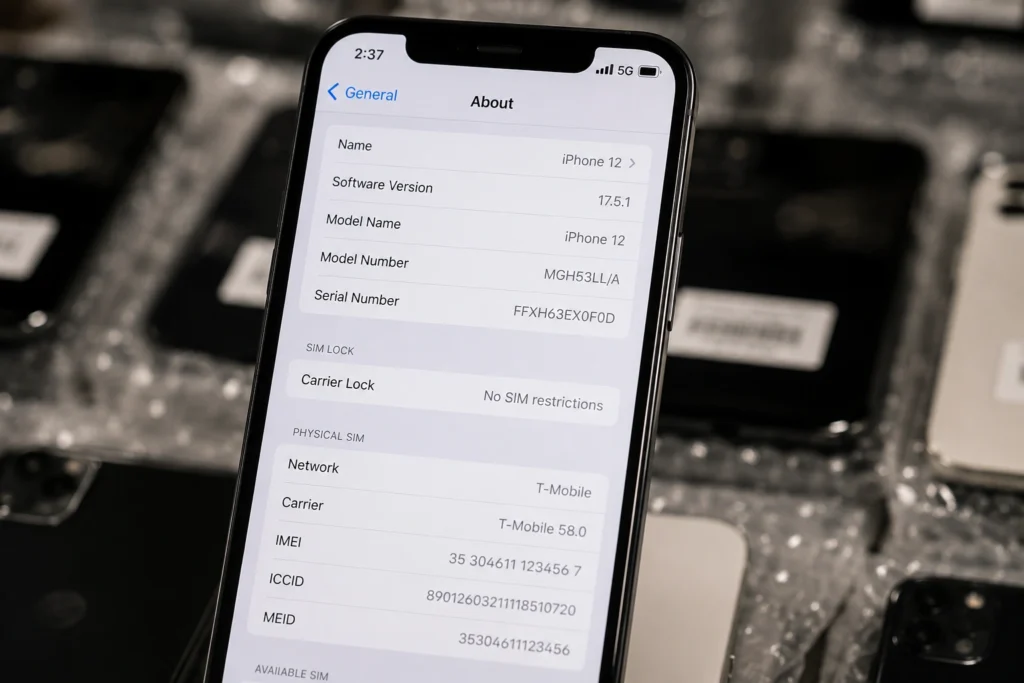
A further complication is that unlock status on these devices can appear to change after the sale. A phone may briefly show no SIM restrictions in its settings, only for the lock to reappear once the original carrier’s database confirms an outstanding balance. Importers should ask suppliers exactly how unlock status was verified and request documentation or a carrier-side confirmation rather than relying on a single on-device settings screenshot.
| Region | Common Carriers | Typical Lock Risk Level |
| United States | AT&T, Verizon, T-Mobile | High for financed devices |
| Japan | docomo, au, SoftBank | Moderate to high |
| South Korea | SKT, KT, LG U+ | Moderate |
| Europe | Multi-carrier markets, mostly unlocked by regulation | Low |
How to Confirm Unlock Status Before You Place an Order
The only reliable way to confirm unlocked vs locked used phones at wholesale volume is to check the IMEI against a carrier or GSMA-backed lookup service before the order is finalized, not after the container ships. This turns unlock verification from a guessing game into a documented checkpoint that both the supplier and importer can reference if a dispute ever arises.
IMEI-Based Verification Process
A proper verification process starts with the supplier providing a full IMEI list for the batch, which the importer or a third-party service then checks against blacklist and carrier-lock databases. Any device flagged as locked, blacklisted, or reported lost or stolen should be pulled from the shipment before payment is finalized, not discovered by the end customer months later. For high-volume orders, batching this check through a spreadsheet or API-based bulk lookup keeps the process fast enough to fit normal quotation timelines.
Working With Suppliers Who Pre-Screen Unlock Status
Established suppliers filter and confirm unlock status before ever listing stock as wholesale unlocked phones, rather than leaving verification entirely to the buyer. When evaluating a new supplier, ask specifically how their quality control pipeline screens for network locks, request a sample batch verification report, and treat a vague or one-line answer as a warning sign rather than reassurance.
| Checklist | Check Item | Why It Matters |
| ✔ | Request full IMEI list for the batch | Enables independent verification instead of relying on the listing description |
| ✔ | Run IMEI check against blacklist and carrier databases | Confirms the device is not reported lost, stolen, or under contract |
| ✔ | Ask for supplier’s unlock confirmation method | Reveals whether lock status was actually tested or simply assumed |
| ✔ | Segregate any flagged units before payment | Prevents locked phones from being mixed into a fully-unlocked shipment |
| ✔ | Keep verification records with the purchase order | Provides a paper trail for customs, resellers, and dispute resolution |
Unlocked vs Locked Stock: Side-by-Side Comparison for Buyers
Weighing unlocked and carrier-locked stock side by side makes the practical trade-offs clear for procurement planning. The table below summarizes the differences importers most often ask about when comparing quotations from different suppliers.
| Factor | Unlocked Used Phones | Carrier-Locked Used Phones |
| Resale market reach | Sellable in any country or carrier network | Restricted to original carrier, if resale is allowed at all |
| Return and complaint risk | Low, since activation works immediately | High, especially with undisclosed lock status |
| Wholesale pricing | Slightly higher, reflecting verified flexibility | Often lower, but carries hidden resale risk |
| Customs and compliance | Straightforward, no activation disputes | Can trigger buyer disputes after clearance |
| Buyer confidence | Higher, supports repeat business with resellers | Lower, especially after one bad batch |
Common Mistakes Importers Make With Network Lock Status
Assuming that grading covers unlock status is the most frequent mistake importers make. Grade A, Grade B, and similar labels describe screen condition, housing wear, and functional performance, not whether a device is tied to a carrier. Treating these as related when they are actually independent checks leaves a real gap in due diligence that only surfaces after resale.
Relying only on a supplier’s verbal claim that stock is unlocked, without an independent IMEI check, is a close second. Verbal assurances are not verifiable after the fact, and when a dispute arises there is no documentation to fall back on. A short IMEI batch check before payment closes this gap at very little cost relative to the size of a typical wholesale order.
Buying mixed lots without segregating locked units by IMEI is another common error, since it only takes a handful of locked phones in an otherwise clean shipment to generate a wave of customer complaints. Importers who accept mixed-lock inventory should insist on a supplier-provided breakdown identifying exactly which units are locked, rather than discovering the split themselves after distribution.
Not accounting for carriers that refuse to unlock secondhand devices entirely is a mistake that catches even experienced buyers off guard. Some networks apply contractual restrictions that persist regardless of remaining balance, meaning a phone can be technically fully paid off yet permanently ineligible for unlock. Suppliers with market-specific experience can flag these edge cases before they become a problem.
Finally, skipping documentation for customs and buyer trust leaves importers exposed if a shipment is challenged or a reseller disputes the condition of stock received. Keeping IMEI verification reports, grading sheets, and supplier quotations together with each purchase order creates a clear paper trail that protects both sides of the transaction.
Building a Reliable Sourcing Process for Unlocked Stock
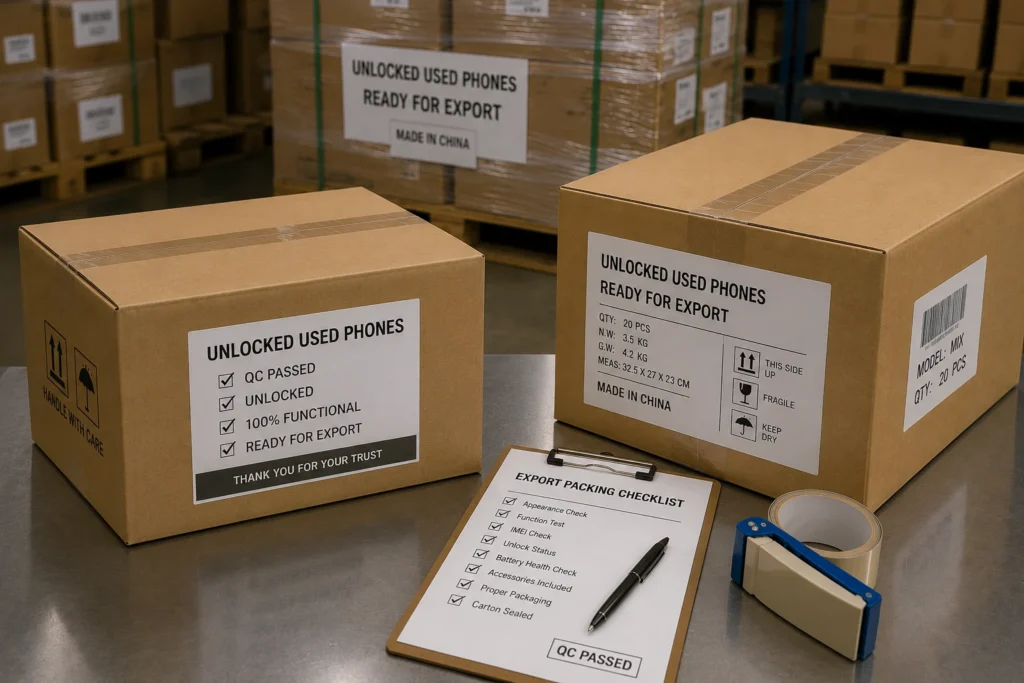
A dependable sourcing process starts at the quotation stage: request that unlocked used phones wholesale be explicitly labeled as such in every quote, with IMEI verification included as a standard line item rather than an optional add-on. Clear MOQ terms, transparent grading, and export-ready packaging should all be confirmed in writing before a deposit is paid, so there is no ambiguity once the order moves into production and shipment.
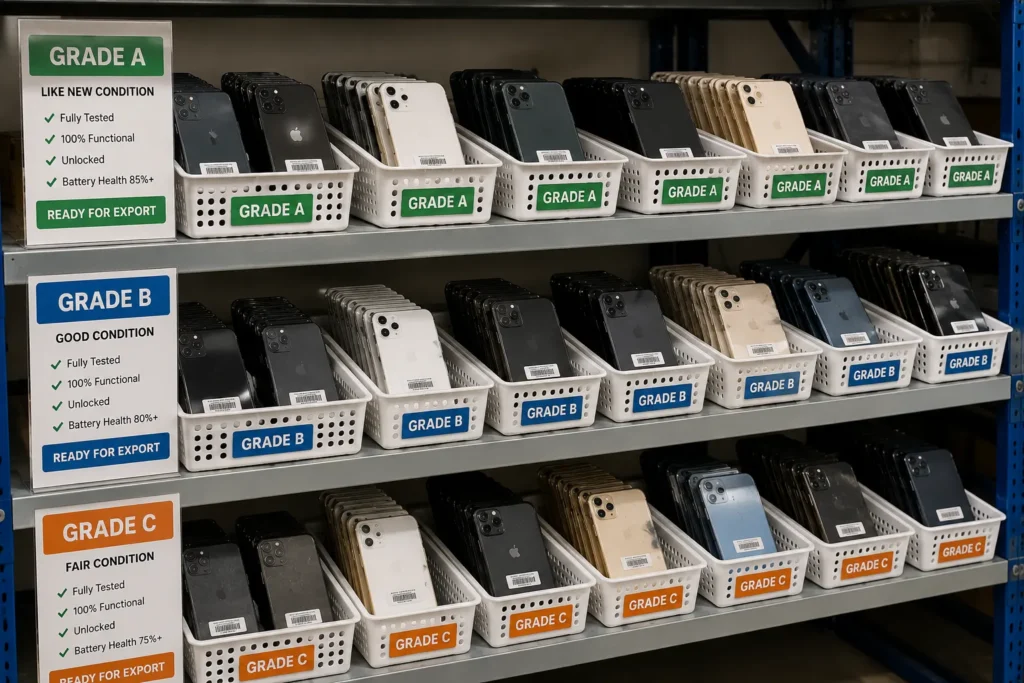
INENG TECHNOLOGY works directly with importers, distributors, and repair shop owners who need dependable, verified unlocked stock at wholesale volume. Every batch can be quoted with clear unlock documentation, grading detail, and export packaging specifications, so buyers can plan resale with confidence instead of discovering problems after a container has already landed.
Ready to Source Verified Unlocked Stock?
Understanding unlocked vs locked used phones is no longer optional for serious importers, since a single overlooked carrier lock can undo the margin on an otherwise well-priced shipment. Building IMEI verification into every purchase order, and specifically requesting wholesale unlocked phones or clearly documented carrier locked iPhones, keeps resale predictable across markets and protects long-term relationships with resellers and end customers alike.
Ask INENG TECHNOLOGY for Unlocked Stock — verified IMEI status, transparent grading, and export-ready packaging on every wholesale order.
Frequently Asked Questions
What does carrier-locked mean for a used phone?
A carrier locked iPhone or Android device only works with SIM cards from its original mobile network. When comparing unlocked vs locked used phones, a locked phone cannot be used on another carrier until the original carrier officially removes the restriction.
Can carrier-locked phones be unlocked later?
Yes, in some cases. Some carrier locked iPhones can be unlocked after the original carrier confirms that all contract or installment payments have been completed. However, some carriers have policies that permanently restrict unlocking.
Are all used iPhones from the US carrier-locked?
No. While many US iPhones are sold through carrier financing, not every device is locked. When buying unlocked used phones wholesale, always verify the IMEI instead of assuming the phone is unlocked.
How can I check unlock status before shipment?
Ask your supplier for the complete IMEI list and verify each device through a trusted carrier or GSMA-backed lookup service before payment. This is the safest way to identify unlocked vs locked used phones and remove any locked devices from the shipment.
Do unlocked phones cost more than locked phones wholesale?
Yes. Unlocked used phones wholesale usually cost slightly more because they work on multiple carrier networks and are easier to resell. Many importers prefer wholesale unlocked phones because they offer greater flexibility and lower business risk.
What happens if I unknowingly import locked phones?
If you import locked devices, customers may not be able to activate them on their networks. This can lead to returns, customer complaints, and financial losses. Understanding unlocked vs locked used phones helps importers avoid these problems.
Can INENG Technology guarantee unlocked stock?
INENG Technology can supply wholesale unlocked phones with IMEI verification documentation included in the quotation. This allows buyers ordering unlocked used phones wholesale to independently confirm the unlock status before shipment.