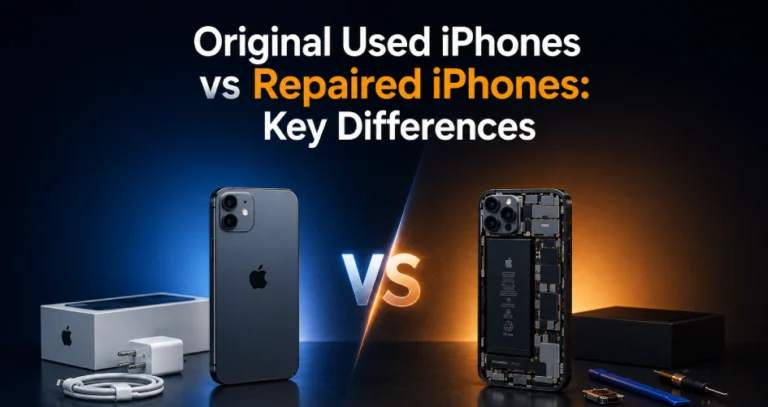
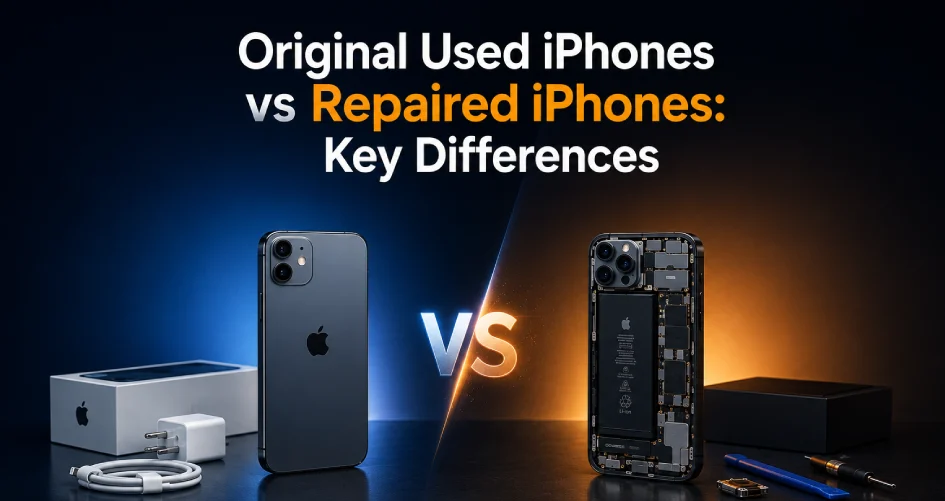
Wholesale buyers sourcing used iPhones from China face one recurring risk: units that look original on the outside but contain repaired or swapped components inside. This gap between appearance and actual condition is exactly where resale trust breaks down for phone store owners, distributors, and e-commerce sellers. Undisclosed repairs can mean lower battery performance, non-original screens, or parts that fail shortly after resale, damaging both margins and customer relationships.
This guide explains exactly how original used iPhones wholesale differ from repaired iPhones wholesale, what grading and testing standards reveal about repair history, and which verification steps protect your business before you commit to a bulk purchase order.
Original Used Phones vs Repaired Units: What Buyers Are Actually Comparing
An original used phone is a device that has never been opened for component replacement and retains its factory-installed screen, battery, camera module, and logic board. The unit may show light cosmetic wear from previous ownership, but every internal part matches Apple’s original manufacturing specification. This is the category most wholesale buyers mean when they request ‘original used iPhones wholesale’ in their sourcing inquiries.
A repaired iPhone has had at least one internal component replaced, most commonly the screen, battery, or charging port, either due to prior damage or a failed part. Repairs range from high-quality OEM-equivalent replacements to low-cost aftermarket parts that visually pass inspection but underperform after a few months of daily use. Repaired iPhones wholesale can still be sold profitably, but only when the repair history is disclosed and priced accordingly.
How Repair History Affects Resale Trust and Buyer Confidence
Repair history is the single biggest factor influencing how confidently your customers will buy from you again. A phone sold as ‘original’ that later reveals a non-original screen or a swapped battery creates a direct credibility problem, not just a product complaint. For repair shop owners and e-commerce sellers, this kind of mismatch generates returns, negative reviews, and disputes that cost far more than the original unit price.
Buyers who understand repair history in advance can price and market inventory correctly. Original used phones can be marketed at a trust premium, while repaired iPhones wholesale should be positioned as a budget-tier option with clear disclosure. Suppliers who document repair history transparently, batch by batch, give resellers the information they need to set accurate expectations downstream.
This is also why sourcing managers increasingly request repair-status reporting alongside standard grading sheets. Knowing whether a unit is original or repaired changes warranty terms, return policy, and even shipping insurance decisions for larger container orders.
Grading Standards for Original Used iPhones vs Repaired Units
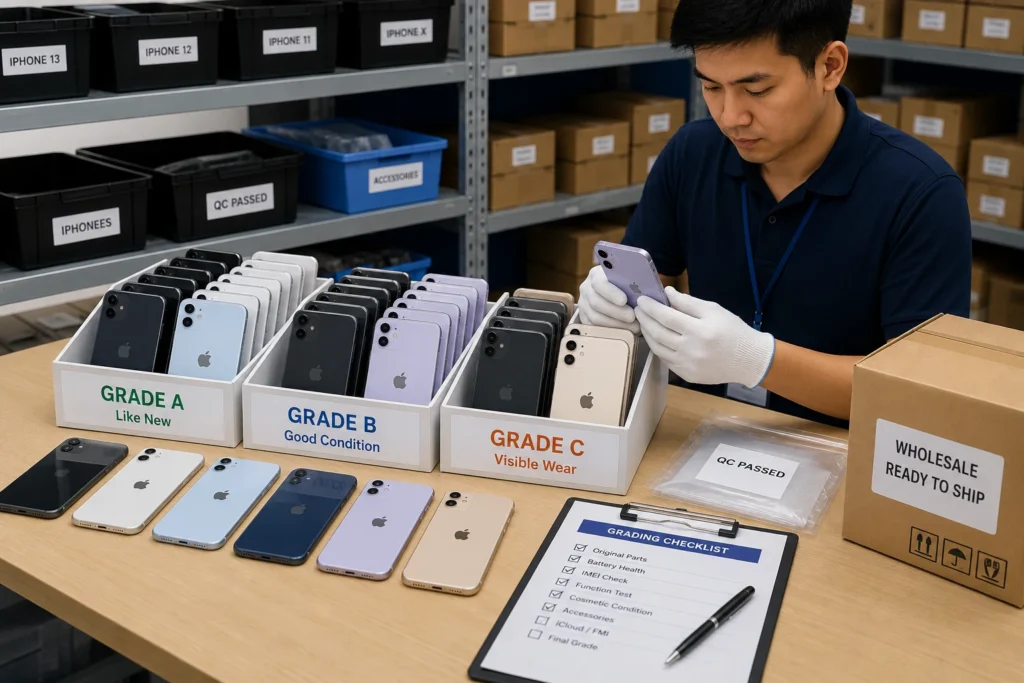
Grading systems (commonly Grade A, Grade B, and Grade C) describe cosmetic condition, but grading alone does not confirm whether a unit is original or repaired. A Grade A phone can still contain a replaced battery, and a Grade B phone can be fully original with only visible scratches. Buyers should request grading reports that separately note cosmetic grade and component originality.
Reliable suppliers combine both data points into a single quality sheet: cosmetic grade for appearance, and a component status flag for originality. This dual reporting format is becoming the expected standard among experienced importers who have been burned by grading reports that only addressed the outside of the device.
| Comparison Point | Original Used iPhones | Repaired iPhones |
| Screen | Factory original, matches serial data | May be OEM-equivalent or aftermarket |
| Battery | Original cell, unmodified health curve | Often replaced, health varies by part quality |
| Resale Positioning | Premium trust tier | Budget or disclosed-repair tier |
| Typical Price Range | Higher wholesale unit cost | Lower wholesale unit cost |
| Buyer Disclosure Needed | Standard grading disclosure | Full repair history disclosure required |
| Warranty Expectations | Standard supplier warranty applies | Shorter or component-specific warranty |
Quality Control Checks That Reveal Repair History
IMEI and Component Verification
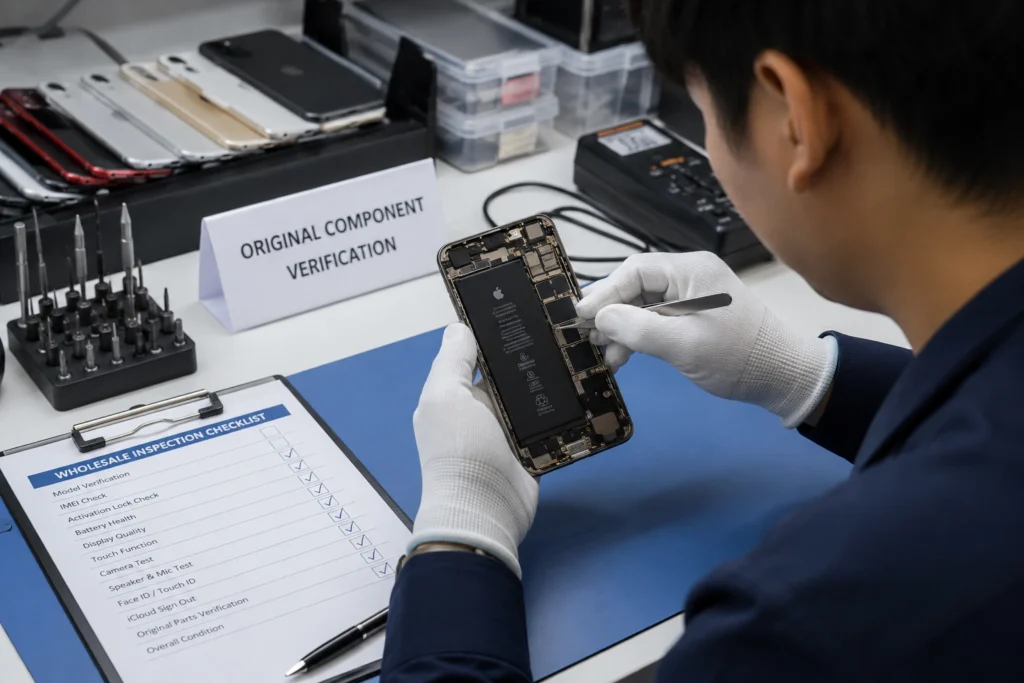
IMEI lookups confirm a device’s original model, storage capacity, and network history, but component verification goes a step further by checking whether the internal parts still match Apple’s original part numbers. Diagnostic software can flag non-original screens, batteries, and cameras even when the phone functions normally, which is essential for catching undisclosed repairs before shipment.
Battery Health and Functional Testing
Battery health reporting shows both maximum capacity and cycle count, and a battery that has been swapped often displays inconsistent data compared to the phone’s overall usage pattern. Functional testing should also confirm Face ID, camera calibration, and charging speed, since replaced components can pass a basic power-on test while still underperforming in daily use.
| Verification Point | Check | Why It Matters |
| IMEI and model match | ✓ | Confirms device authenticity and network history |
| Battery health percentage | ✓ | Reveals if the original cell is still installed |
| Screen part-number check | ✓ | Detects aftermarket or OEM-equivalent replacements |
| Face ID and camera calibration | ✓ | Confirms sensors are original and undamaged |
| Charging port and speed test | ✓ | Flags previously repaired charging components |
Procurement Strategy: MOQ, Pricing, and Supplier Evaluation
When requesting quotations, ask suppliers to quote original used stock and repaired stock as separate line items, even within the same model and storage tier. This prevents blended pricing from hiding the true ratio of repaired units in a shipment and gives your team clean data for margin planning. Most wholesale suppliers can accommodate MOQs starting between 50 and 100 units per model for original stock.
Evaluate suppliers on their willingness to share batch-level testing reports before shipment, not just after a dispute arises. A supplier confident in their original stock will typically offer sample units, video verification calls, or third-party inspection access without hesitation, which is a strong signal of genuine supply chain transparency.
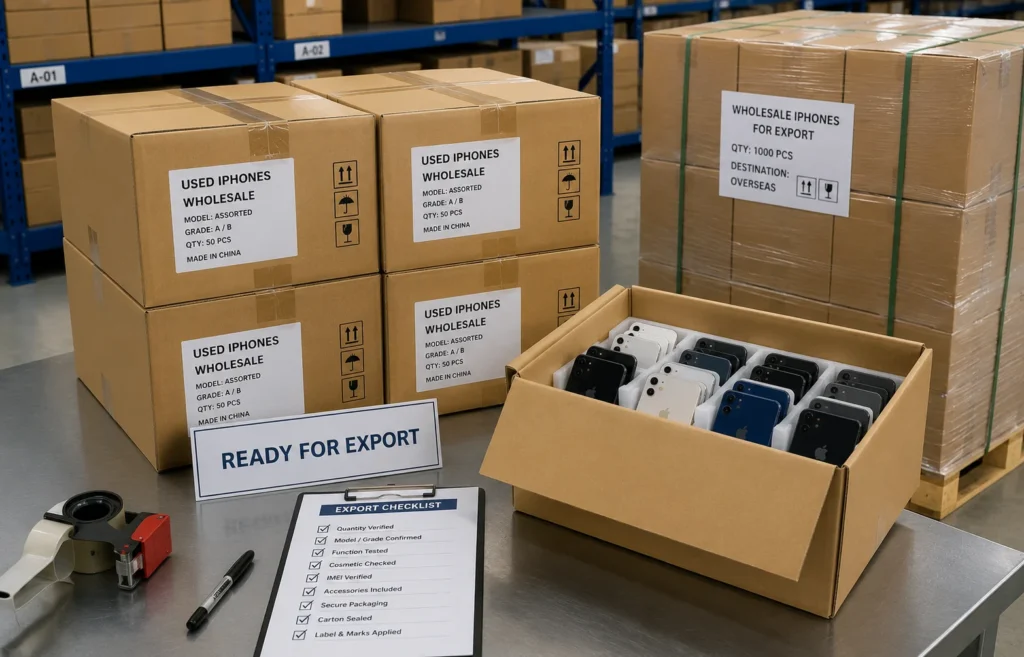
For import risk reduction, request that packaging and export documentation clearly separate original and repaired cartons, especially for mixed-model container shipments. This makes customs declarations more accurate and simplifies quality claims if any batch arrives with unexpected condition issues.
Common Mistakes Buyers Make When Sourcing Wholesale iPhones
The first common mistake is accepting a single blended grading report that covers cosmetic condition only, without any statement on component originality. Buyers who skip this step often discover repaired batteries or screens only after resale complaints begin, at which point the shipment has already been distributed to end customers and the cost of correction is much higher.
The second mistake is assuming a higher price automatically means original components. Some suppliers price repaired units at near-original rates simply because the repair used high-quality parts, which misleads buyers who are pricing purely off supplier quotes rather than requesting explicit repair-status documentation for each batch.
The third mistake is skipping sample orders before committing to full container volumes. A small sample order, even 20 to 30 units, gives your team a chance to run independent IMEI and battery checks and confirm the supplier’s reporting matches reality before scaling up the relationship.
The fourth mistake is relying only on functional testing while ignoring part-number verification. A phone can power on, make calls, and charge normally while still containing an aftermarket screen or replaced battery, so functional testing alone is not sufficient proof of original condition.
The fifth mistake is failing to document repair status in your own resale listings. Even when a supplier discloses repaired units honestly, some resellers omit this detail downstream, which shifts the trust problem onto their own customers and increases return rates once the difference is discovered.
Buy With Repair History in Full View
Distinguishing original used iPhones wholesale from repaired iPhones wholesale is not about avoiding repaired stock altogether, it is about buying with full visibility into what each batch actually contains. Buyers who request separated grading and repair-status reports, verify component originality, and start new supplier relationships with sample orders consistently protect their margins and their resale reputation.
INENG Technology documents component originality and repair status on every batch of used iPhones we export, giving wholesale buyers the transparency needed to price, market, and warranty their inventory with confidence.
Request Original Used Stock
Source With Confidence, Every Shipment INENG Technology supplies fully verified original used iPhones wholesale, with complete IMEI history, functional testing, and grading transparency for every batch. No hidden repairs, no surprises at unboxing.
Frequently Asked Questions
What is the main difference between original used iPhones wholesale and repaired iPhones wholesale?
Original used iPhones wholesale retain all factory-installed components, while repaired iPhones wholesale have one or more parts, such as the screen or battery, replaced during previous ownership or refurbishment.
Can repaired iPhones wholesale still be sold profitably in wholesale markets?
Yes. Repaired iPhones wholesale remain a profitable option when the repair history is clearly disclosed and pricing reflects the replaced components. They are a popular choice for budget-focused resale markets.
How can I verify component originality before buying original used iPhones wholesale?
When purchasing original used iPhones wholesale, request part-number diagnostic reports along with IMEI verification. A sample order or third-party inspection can also help confirm that the original used phones match the supplier’s documentation.
Does battery health data confirm whether a phone is one of the original used phones?
Battery health can help identify a replacement battery if the percentage or cycle count does not match the phone’s overall usage. However, it should always be checked together with part-number verification when sourcing used iPhones wholesale.
What MOQ should I expect for original used iPhones wholesale?
Most suppliers of original used iPhones wholesale offer minimum order quantities of 50 to 100 units per model. Smaller sample orders are often available for first-time buyers.
Should original used phones and repaired iPhones wholesale be packaged separately for export?
Yes. Separating original used phones and repaired iPhones wholesale into different cartons makes customs clearance easier and helps track product quality if any issues arise after delivery.
How does repair history affect warranty terms for used iPhones wholesale?
Original used iPhones wholesale usually come with the supplier’s standard warranty, while repaired iPhones wholesale often include shorter or component-specific warranty coverage because replacement parts may carry additional risk.