
Buyers who want to source refurbished phones from China face a crowded supplier market where capability, quality, and pricing vary enormously from one factory to the next. Choosing a supplier without a clear evaluation framework often leads to inconsistent grading, undisclosed defects, and shipments that do not match what was quoted. This guide walks wholesale buyers, importers, distributors, and phone store owners through seven practical steps for sourcing refurbished phones wholesale — from identifying the right supplier type through confirming export documentation — so you can evaluate any refurbished phone supplier in China with confidence and build a reliable, repeatable procurement process.
Identify the Right Supplier Type in China
The first decision that shapes every later stage of the sourcing process is understanding what type of refurbished phone supplier you are actually working with. China’s refurbishment industry includes two broad categories of supplier, and knowing the difference helps you ask the right questions, set realistic expectations for documentation, and understand who is accountable if a quality issue arises after shipment.
Factory-Direct Refurbishers
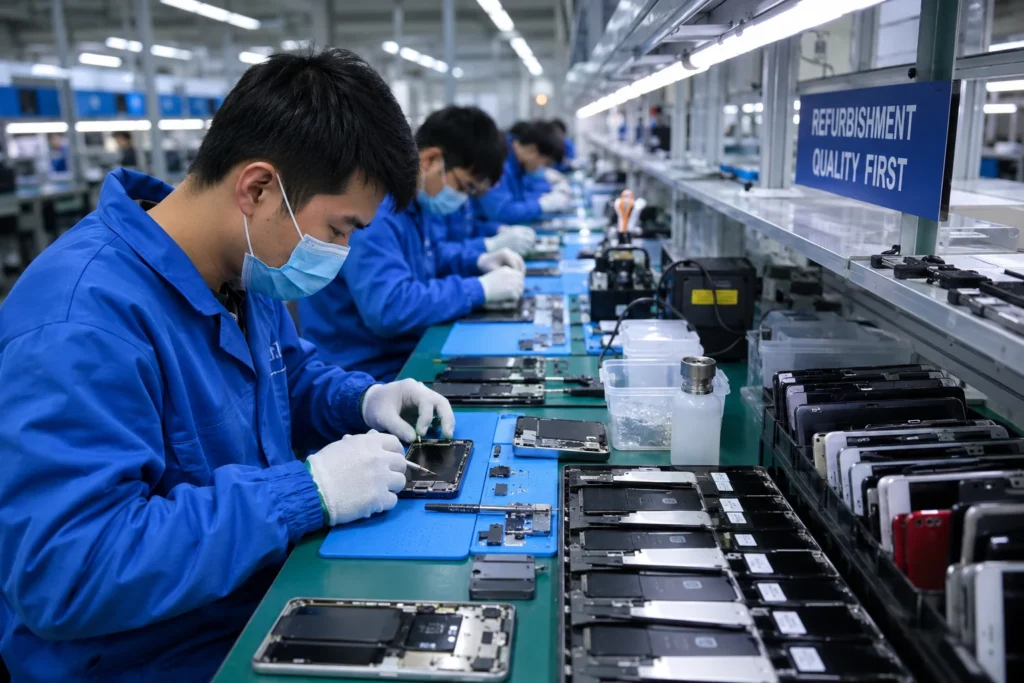
Factory-direct suppliers operate their own disassembly, repair, and testing lines, which gives them tighter control over grading consistency and defect rates than an intermediary can typically offer. Because they perform the refurbishment work themselves, they can usually provide more detailed documentation — repair logs, component sourcing information, and batch-level testing records — and are often more willing to accommodate custom grading requirements or private-label packaging for buyers placing larger, recurring orders. This makes factory-direct suppliers a strong fit for buyers who prioritize consistency and traceability over the widest possible model selection.
Trading Companies and Intermediaries
Trading companies can be a practical option for buyers who want smaller order quantities or access to a wider mix of models than a single factory produces, since they often aggregate stock from several refurbishment workshops under one roof. The trade-off is reduced visibility into the actual refurbishment process, so it becomes even more important to request documentation, sample inspections, and clear accountability for defects before committing to a bulk order through this type of supplier. Neither model is inherently better; the right choice depends on your order volume, your tolerance for variability, and how much documentation you need to satisfy your own customers or import regulations.
Because the right supplier type also depends on your business model, use the table below as a starting framework for matching your business type to a recommended supplier type, grading focus, and stock format before you request a quotation. Treat it as a practical starting point rather than a fixed rule, and adjust based on your own sell-through data as you build a track record with a given supplier.
| Business Type | Recommended Supplier Type | Recommended Grade Focus | Recommended Stock Format |
| Budget retailer / street shop | Trading company | Grade B / C | Mixed grade lots |
| Online marketplace seller | Factory-direct refurbisher | Grade A / A+ | Single grade or model-specific lots |
| Repair shop / parts recovery | Trading company or factory | Grade C / As-Is | Mixed grade or salvage lots |
| Premium retailer / boutique | Factory-direct refurbisher | Grade A+ | Single grade, model-specific lots |
| Distributor / importer (large volume) | Factory-direct with trader backup | Mixed A–C, tiered | Bulk container orders |
Confirm Grading Standards in Writing
Once you have a shortlist of potential suppliers, the next step is to look closely at how each one defines device condition. Grading terminology is one of the most common sources of confusion when buyers source refurbished phones from China, largely because there is no single global standard that every supplier follows. A grade that one supplier labels as ‘Excellent’ might correspond to what another calls ‘Grade A,’ and the acceptable cosmetic and functional tolerances behind each label can differ significantly between vendors, even when the wording looks identical on a quotation sheet.
| Grade | Condition Description | Typical Resale Use |
| Grade A+ / Excellent | Like-new appearance; original screen and housing with no visible wear | Premium resale, retail counters, warranty-backed e-commerce listings |
| Grade A / Good | Minimal signs of use; light micro-scratches not visible at a glance | Mainstream retail and online resale at competitive pricing |
| Grade B / Fair | Noticeable scratches or minor cosmetic wear; fully functional | Budget resale markets, bundled promotions, value-tier listings |
| Grade C / As-Is | Significant cosmetic wear; may include non-original parts | Repair shops, parts recovery, deep-discount resale |
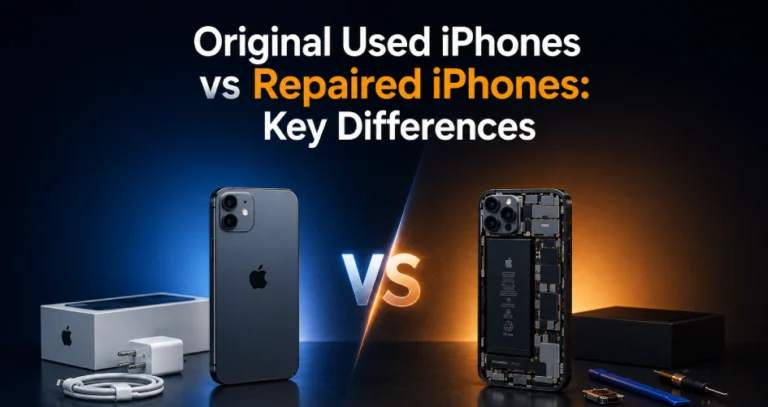
Reviewing your supplier’s Refurbished Phone Grading Standards Guide in detail, rather than assuming grades are interchangeable across vendors, will save you from costly misunderstandings later in the relationship. Beyond the cosmetic description, ask your supplier whether refurbished units include original OEM parts or high-quality aftermarket components, particularly for screens and batteries, since this distinction can materially affect both performance and how you should represent the product to your own customers. A trustworthy refurbished phone supplier in China will disclose this information proactively rather than waiting for you to ask, and that willingness is itself a useful signal of how transparent the rest of the relationship is likely to be.
Verify Battery Health and IMEI Status
With grading standards confirmed, the next step is to move past cosmetic condition and verify the functional reliability that ultimately determines your return rate and customer satisfaction. Battery health and IMEI status are the two checks that carry the most weight at this stage, since problems in either area can make a device unsellable regardless of how good it looks.
Battery Health Verification
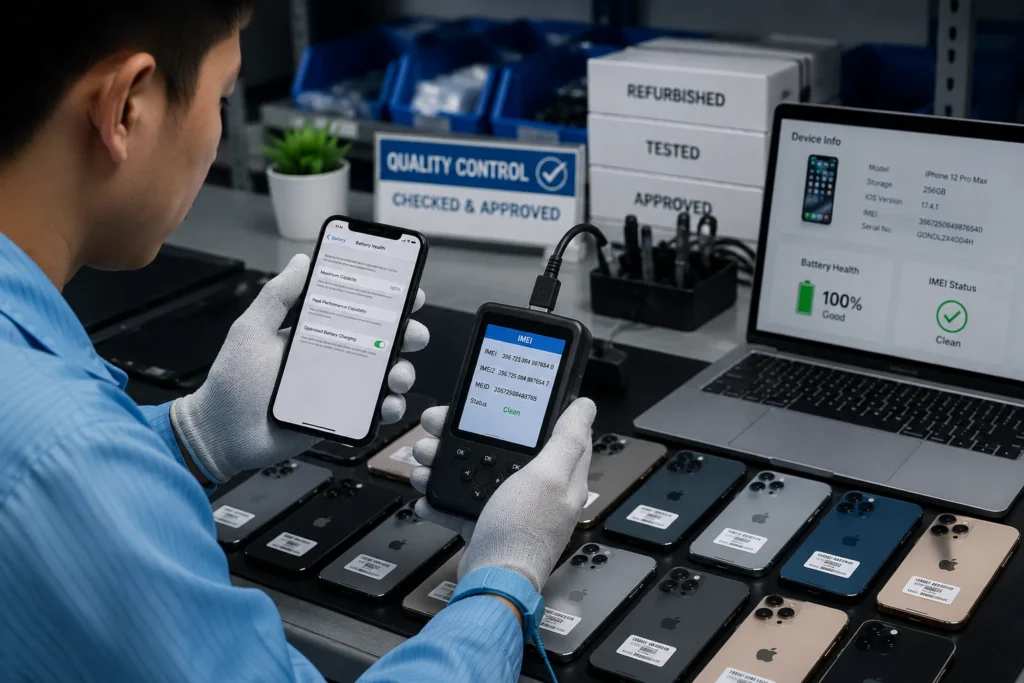
Battery replacement is a standard part of most refurbishment processes, but the quality of replacement batteries varies widely between suppliers, and this variance is rarely visible from a photo or spec sheet alone. Ask whether batteries are original capacity-rated cells or lower-cost alternatives, and request a battery health report showing capacity percentage for each unit or batch before you agree to a shipment. Most experienced wholesale buyers set a minimum threshold of 85% or higher for refurbished stock, since a freshly refurbished phone should generally perform close to new in this respect, and anything below that threshold should be disclosed and priced separately rather than blended into standard grades.
IMEI and Activation Status Checks
Every phone in a wholesale refurbished phones order should be checked against IMEI blacklist databases to confirm it has not been reported lost, stolen, or tied to an unpaid financing agreement, and that it is free of carrier locks, iCloud locks, or MDM restrictions that would prevent your customers from activating it. Request IMEI verification reports as a standard part of your quality documentation, and treat any resistance to providing this information as a serious warning sign rather than a minor inconvenience, since this is one of the fastest and least expensive checks available relative to the financial risk it protects against.
Review Functional Testing Documentation
Battery and IMEI checks address two specific risk points, but a complete quality picture requires confirming that every functional component of the device has been tested and recorded before the unit is graded and packed. This step is where you separate suppliers who genuinely inspect each device from those who rely on visual sorting alone.
- Display quality (touch response, dead pixels, screen burn-in)
- Camera function, focus, and flash operation (front and rear)
- Biometric authentication (Face ID, Touch ID, or fingerprint sensor)
- Charging port function, wireless charging, and battery charging cycle
- Speaker, microphone, and earpiece audio clarity
- Wi-Fi, Bluetooth, and cellular network connectivity
- Physical buttons, switches, and vibration motor response
A supplier that documents this testing process in writing, ideally with photos or short videos per batch, significantly reduces the burden of inbound inspection on your side and gives you confidence that the grading you paid for matches the functional reality of the devices you receive. If a supplier cannot describe how they test for these specific issues, it is reasonable to assume that some proportion of incoming stock is being graded on appearance alone, which increases the likelihood of functional complaints once devices reach your customers.
Negotiate MOQ, Pricing, and Quotation Terms
Once grading and quality control expectations are clear, the practical next step is understanding how refurbished phone suppliers in China structure their stock offerings, minimum order quantities, and pricing, since these directly affect how you plan cash flow and negotiate terms for your first and subsequent orders.
| Stock Type | Description | Best For |
| Mixed Grade Lots | Multiple grades and models bundled at a blended average price | Buyers seeking the lowest entry cost and flexible resale mix |
| Single Grade Lots | All units meet one consistent grading standard | Retailers needing predictable quality for storefront or online listings |
| Model-Specific Lots | One model and storage configuration per order | E-commerce sellers running targeted listings or ad campaigns |
| Bulk Container Orders | Large-volume, pallet or container-level shipments | Established distributors and importers with high monthly turnover |
MOQ requirements vary considerably: mixed-grade lots often have the lowest entry threshold, while model-specific or single-grade orders typically require higher minimums because the supplier must sort more selectively from a larger pool of inventory to fill your exact specification. Always request a written quotation that itemizes price per grade and per model, along with any volume discount tiers and payment terms, so you can compare wholesale refurbished phones offers across suppliers on a like-for-like basis rather than relying on a single blended number that can obscure real differences in quality.
Request a Sample Order Before Scaling
Before committing to a full container or large recurring order, it is worth treating your first purchase from any new supplier as a controlled test rather than a full-scale commitment. A sample order — typically a small batch across the grades and models you intend to carry long term — gives you the opportunity to verify that grading, battery health, IMEI status, and functional testing all match what was documented in the quotation, without exposing your business to the financial risk of a large shipment that turns out to be inconsistent.
When your sample arrives, inspect it methodically: check a statistically meaningful portion of the batch against the grading definitions you were given, confirm battery health readings independently rather than relying solely on the supplier’s report, and test a representative sample of units across all of the functional points listed in Step 4. Track the defect rate you find and compare it to what would be acceptable for your resale channel. Suppliers confident in their own quality control processes will rarely object to this step, and their willingness to accommodate a sample order is itself a useful indicator of how they are likely to handle larger orders going forward.
Confirm Packaging and Export Documentation
Even the best-graded, best-tested refurbished phones can arrive damaged or delayed if packaging and export documentation are not handled properly, so this final step deserves the same attention as supplier selection and quality control earlier in the process.
Packaging Standards to Confirm
- Anti-static bags or individual protective sleeves for each device
- Foam or bubble padding between units and box walls
- Sealed cartons labeled clearly with model, grade, and quantity
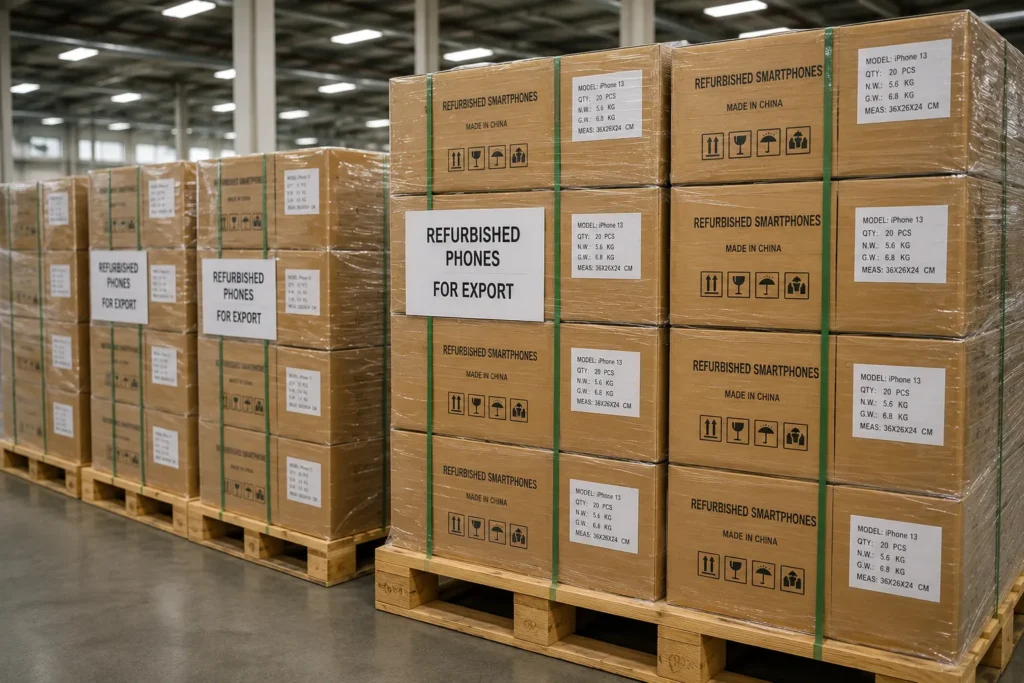
- Reinforced pallet wrapping for container or bulk-volume shipments
Export Documentation and Customs Preparation
Request a commercial invoice and packing list that itemizes model, grade, and declared value, since incomplete paperwork is a common cause of shipments being delayed at customs for review. A supplier experienced in international logistics should be able to guide you through HS code classification and support your preferred incoterm, whether that is FOB, CIF, or EXW, and should provide realistic transit time estimates so you can plan inventory and cash flow around an actual shipment date rather than an optimistic best case. For more detail on this process, see our Shipping & Export Guide for Bulk Orders.
Common Mistakes to Avoid When You Source Refurbished Phones from China
Choosing a Supplier Based on Price Alone
The lowest quotation often reflects lower-grade components, unverified battery health, or skipped functional testing steps, and buyers who prioritize price over documented quality frequently discover the true cost only after a shipment arrives with a higher-than-expected defect rate. The savings from a cheaper quote are quickly erased once you account for returns, customer complaints, and the time spent resolving disputes with a supplier who was never fully transparent about how devices were tested in the first place.
Not Distinguishing Between Factory-Direct and Trading Suppliers
Buyers who assume every supplier operates the same way often struggle to get clear answers when a quality issue arises, simply because a trading company may not have direct visibility into how a device was actually refurbished. Understanding which type of supplier you are working with from the outset, as outlined in Step 1, sets realistic expectations for documentation, accountability, and response time on any disputes that arise later.
Skipping IMEI and Battery Verification
Failing to confirm IMEI status and battery health before shipment can result in units that cannot be legally activated or resold in your market, or that fail within weeks of reaching your customers. Both checks are inexpensive and fast relative to the cost of handling a wave of returns, yet they remain among the most commonly skipped steps by first-time buyers eager to move quickly on a quotation.
Ordering at Full Volume Without a Sample Shipment
Committing to a full container order without first testing a smaller sample, as described in Step 6, removes your ability to verify that grading, packaging, and documentation match what was promised in the quotation. A sample order represents a small, recoverable cost compared to discovering systemic quality issues for the first time in a shipment of several thousand units.
Overlooking OEM vs. Aftermarket Parts Disclosure
Assuming all refurbished phones use original manufacturer components can lead to unpleasant surprises, particularly with screens and batteries, since aftermarket parts can affect both performance and how confidently you can market the product to your own customers. Always ask suppliers to disclose parts sourcing explicitly rather than assuming it based on grade alone.
Pre-Order Buyer Checklist
Before you place a bulk order, work through the checklist below with your supplier. It consolidates the seven steps covered in this guide into a single reference you can use during negotiations, and completing it in writing gives you a clear record to refer back to if a shipment does not match what was agreed.
| Wholesale Used iPhone Supplier Checklist | Status |
|---|---|
| Supplier type confirmed (factory-direct or trading company) and matched to your order needs | ☐ |
| Business license and export credentials verifiable on request | ☐ |
| Written grading definitions provided with sample photos or live video inspection | ☐ |
| OEM vs. aftermarket parts disclosure obtained, especially for screens and batteries | ☐ |
| Battery health reports provided per unit or per batch, with an agreed minimum threshold | ☐ |
| IMEI verification confirming no blacklist, carrier lock, or iCloud/MDM lock | ☐ |
| Functional testing checklist confirmed and documented in writing | ☐ |
| MOQ, unit pricing, and volume discount tiers confirmed in a written quotation | ☐ |
| Payment terms and deposit requirements agreed and documented | ☐ |
| Sample order completed and inspected before scaling to a full container order | ☐ |
| Packaging standard and carton labeling confirmed before production | ☐ |
| Export documentation (commercial invoice, packing list, HS code) confirmed | ☐ |
| Return or replacement policy for DOA (dead-on-arrival) units confirmed | ☐ |
Sourcing Refurbished Phones with Confidence
Successfully sourcing refurbished phones from China comes down to following the seven steps in this guide in order: identify the right supplier type, confirm grading standards in writing, verify battery health and IMEI status, review functional testing documentation, negotiate MOQ and pricing transparently, request a sample order before scaling, and confirm packaging and export documentation. Buyers who apply this framework consistently are far better positioned to build a reliable, repeatable wholesale refurbished phones supply chain rather than gambling on a single low quotation.

INENG TECHNOLOGY CO., LIMITED works with international wholesalers, distributors, and e-commerce sellers to supply graded, tested, and export-ready refurbished phones, backed by transparent documentation and flexible stock options across major models and grades.
Request Wholesale Quotation
Contact our sourcing team today to receive current stock availability, grading options, and pricing tailored to your refurbished phone resale business. Whether you need mixed-model inventory or model-specific wholesale orders, we’ll recommend the best sourcing solution based on your business requirements. Our team can also provide grading documentation, battery health standards, MOQ details, export information, and estimated lead times before you place your order.
Request a personalized quotation today and source high-quality wholesale refurbished phones with confidence from a trusted China supplier.
Frequently Asked Questions
What does it mean to source refurbished phones from China?
To source refurbished phones from China means working with Chinese factories or experienced trading companies that collect, repair, test, grade, and resell used smartphones in bulk. These businesses specialize in refurbished phones wholesale, allowing international buyers to purchase large quantities at competitive prices compared with domestic sourcing.
How do I evaluate a refurbished phone supplier in China before ordering?
Before placing an order with a refurbished phone supplier China exporter, request business registration documents, written grading standards, battery health reports, IMEI verification, and documented functional testing results. It is also recommended to place a small sample order before purchasing larger volumes of wholesale refurbished phones.
What is the difference between factory-direct and trading company suppliers?
Factory-direct suppliers perform refurbishment in-house and typically provide greater transparency regarding testing, grading, and replacement parts. Trading companies source inventory from multiple refurbishment facilities and may have less direct visibility into the repair process. Understanding this difference is important when you source refurbished phones from China.
What battery health should I expect from wholesale refurbished phones?
Most experienced buyers expect wholesale refurbished phones to have a minimum battery health of around 85%. Suppliers should clearly state their battery standards and provide battery health reports whenever possible, especially for larger refurbished phones wholesale orders.
Are OEM parts always used in refurbished phones?
No. Some suppliers use original manufacturer (OEM) components, while others install high-quality aftermarket parts, particularly for screens and batteries. When working with a refurbished phone supplier China, always request written confirmation of the parts used before placing your order.
What is a typical MOQ for wholesale refurbished phones?
The minimum order quantity varies depending on the inventory available. Mixed-model and mixed-grade lots usually have lower MOQs, while model-specific or premium-grade wholesale refurbished phones generally require higher minimum purchase quantities because of more selective sorting.
How can I reduce import risk when sourcing refurbished phones wholesale?
To reduce risk when purchasing refurbished phones wholesale, verify IMEI reports, battery health documentation, grading standards, and export paperwork before shipment. Request a sample order first and work with a reputable refurbished phone supplier China that can provide references from international buyers.
How long does shipping take for bulk refurbished phone orders from China?
Shipping times depend on your destination and shipping method. Air freight offers faster delivery, while sea freight is generally more economical for larger shipments of wholesale refurbished phones. Your supplier should provide an estimated transit time based on your order size and shipping terms when you source refurbished phones from China.