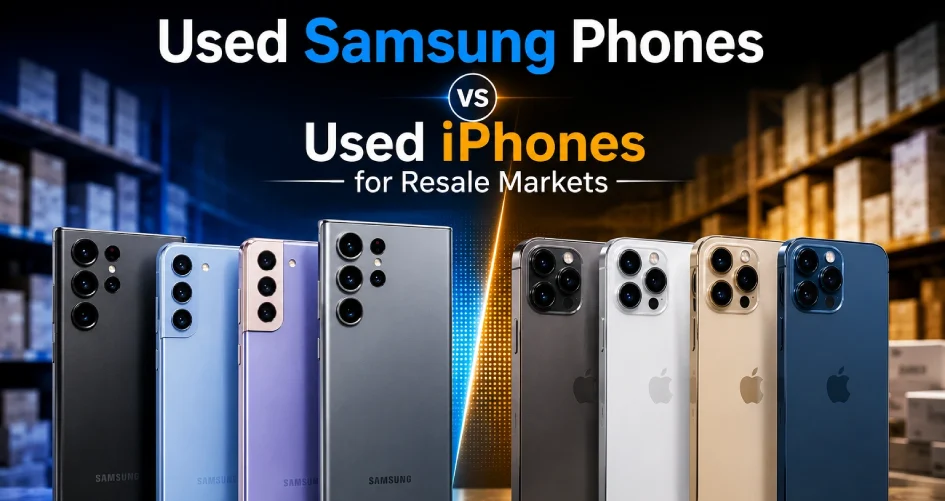
Used Samsung phones vs used iPhones is one of the most important comparisons for wholesale buyers building resale inventory. Choosing between the two is rarely just a matter of brand preference. Import duties, network compatibility, local purchasing power, and repair infrastructure all influence which devices perform better in a specific market. Many first-time importers assume that iPhones always generate higher resale margins, only to discover that used Samsung phones wholesale stock often sells faster in price-sensitive regions due to its affordability and broad consumer demand.
To make the right sourcing decision, buyers need to compare more than just brand recognition. Understanding used Samsung phones vs used iPhones requires evaluating grading standards, cosmetic condition, battery health verification, functional testing, spare parts availability, and regional demand trends. This guide compares these key factors to help sourcing managers, distributors, and resellers build profitable inventory based on real market data rather than assumptions.
Why the Samsung vs iPhone Decision Shapes Your Resale Profitability
The choice between used Samsung phones and used iPhones affects far more than unit cost. Samsung’s broad model range and Android ecosystem allow buyers to serve multiple price tiers from a single supplier relationship, while iPhones tend to hold resale value longer and command stronger buyer trust in markets where Apple’s brand recognition is high. Sourcing managers who treat this as a single universal decision often end up with mismatched inventory that sits in a warehouse instead of turning over quickly. A more effective approach is to map brand selection directly to the resale market, customer budget, and repair capability of each region you serve.
Margin structure also differs between the two brands. Used iPhones wholesale pricing is generally more stable and transparent because Apple releases fewer models per year, making price benchmarking straightforward for buyers and sellers alike. Used Samsung phones wholesale pricing varies more widely across flagship, mid-range, and budget series, which gives resellers more flexibility to build tiered catalogs but also requires closer supplier communication to avoid overpaying for out-of-cycle models.
Buyer Profiles That Favor Each Brand
Repair shops and independent phone stores in emerging markets often prefer used Samsung phones because parts availability is wider and consumers are accustomed to Android devices at every price point. E-commerce sellers targeting developed markets frequently lean toward used iPhones because listings convert faster, return rates are lower, and buyers associate the brand with longer software support. Distributors serving mixed markets typically stock both brands but adjust the ratio based on which one their specific buyer base actually resells fastest.
| Buyer Type | Samsung Fit | iPhone Fit | Primary Driver |
| Repair shops | Strong | Moderate | Parts availability and Android familiarity |
| E-commerce sellers | Moderate | Strong | Faster conversion, lower return rates |
| Distributors (mixed markets) | Strong | Strong | Balanced catalog for varied buyer budgets |
| Budget retailers | Strong | Weak | Lower price points across more models |
| Premium resellers | Moderate | Strong | Higher resale value and brand trust |
Grading Standards Comparison: Used Samsung Phones vs Used iPhones Wholesale
Grading systems for used Samsung phones and used iPhones follow similar letter tiers, typically Grade A+, A, B, and C, but the underlying inspection criteria differ because of hardware design. Samsung’s AMOLED and Super AMOLED displays are evaluated for burn-in and color uniformity, which is not a concern on iPhone’s LCD or OLED panels in the same way. Apple devices are graded more heavily on frame condition, screen glass integrity, and Face ID or Touch ID functionality, since these features are central to buyer expectations.
Buyers who apply a single grading checklist to both brands risk misjudging condition. A supplier’s internal grading language should always be requested in writing and cross-checked against sample units before a first order, since terminology such as “like new” or “fair” can vary between factories even within China’s refurbishing hubs.
| Grade | Samsung Criteria | iPhone Criteria |
| Grade A+ | No scratches, no AMOLED burn-in, full original parts | No scratches, 100% battery health target, original screen |
| Grade A | Minor micro-scratches, screen fully functional | Minor micro-scratches, battery health 85%+ |
| Grade B | Visible wear, light AMOLED shadowing acceptable | Visible wear, battery health 80%+, minor frame dents |
| Grade C | Heavy wear, functional but cosmetically rough | Heavy wear, functional, may need battery replacement soon |

Once grading criteria are clearly defined for each brand, the next priority for buyers is confirming that units pass functional and battery testing before shipment, since grading alone does not guarantee a phone performs as described.
Quality Control, Battery Health, and IMEI Verification for Both Brands
Quality control workflows for used Samsung phones and used iPhones overlap in structure but diverge in the specific diagnostics used. Both brands require functional testing of the display, cameras, speakers, charging port, buttons, sensors, and network connectivity before a unit is approved for wholesale packing. The difference lies in the tools used to pull diagnostic data, since Samsung devices rely on Android diagnostic dialer codes and third-party testing apps, while iPhones use Apple’s own battery health reporting and activation lock verification.
Battery Health Verification Differences
For used iPhones wholesale buyers, battery health percentage is a standardized, Apple-reported figure that is easy to verify on the device itself, which is why many buyers request a minimum threshold such as 85% in their purchase agreement. Samsung devices do not expose a single standardized battery health percentage in the same way, so buyers should instead request cycle count data or voltage testing results from the supplier, and confirm the phone holds a charge under real use conditions during sample inspection.
IMEI and Carrier-Lock Checks
IMEI verification is equally critical for both brands and should confirm three things: the device is not reported lost or stolen, it is not carrier-locked in a way that blocks resale in the destination market, and the IMEI on the physical device matches the IMEI in the system records. Buyers sourcing in bulk should request a full IMEI list from the supplier before shipment and run an independent check rather than relying solely on the supplier’s own verification report.
| QC Step | Used Samsung Phones | Used iPhones |
| Battery check | Cycle count / voltage test | Battery health percentage report |
| Lock status | Google/FRP lock verification | iCloud activation lock verification |
| IMEI check | Blacklist and carrier check | Blacklist and carrier check |
| Display test | AMOLED burn-in and touch response | True Tone and touch response |
| Software check | Android version and bloatware removal | iOS version and jailbreak detection |
Regional Market Preferences: Matching Phones for Resale to Local Demand
Regional demand is one of the strongest predictors of resale success, often more influential than brand loyalty alone. Africa and South Asia tend to favor used Samsung phones because Android devices are available across a wider price range and local repair networks are more familiar with Samsung parts. Latin America shows strong demand for both brands, with iPhones performing well in urban centers and mid-range Samsung models selling faster in smaller cities and rural areas.
The Middle East and parts of Southeast Asia frequently show strong demand for used iPhones, driven by brand prestige and a large expatriate customer base accustomed to Apple devices. Distributors serving Eastern Europe often report a more even split, with buyers requesting both brands depending on carrier compatibility with local 4G and 5G bands, which makes network band verification an essential sourcing step regardless of brand.
| Region | Stronger Demand | Key Reason |
| Africa | Samsung | Wider price range, familiar repair ecosystem |
| South Asia | Samsung | Budget-tier availability and Android preference |
| Latin America (urban) | iPhone | Brand prestige, strong resale value |
| Latin America (rural) | Samsung | Lower price points sell faster |
| Middle East | iPhone | High brand prestige, expatriate customer base |
| Eastern Europe | Even split | Carrier band compatibility drives choice |

Pricing, MOQ, and Wholesale Quotations: Samsung vs iPhone Sourcing
Pricing structures for used Samsung phones wholesale and used iPhones wholesale differ enough that buyers should request separate quotations rather than assuming one pricing model applies across brands. iPhone quotations are typically organized by model, storage capacity, and battery health tier, since these three factors most directly affect resale value. Samsung quotations are usually organized by model series, storage, and grade, with color and regional variant sometimes affecting price as well.
Minimum order quantities also tend to differ. Established suppliers often set lower MOQs for popular iPhone models because demand is predictable and stock turns over quickly, while Samsung MOQs may vary more by series since older or regional-only models can be harder to move in volume. Buyers new to a supplier should request a mixed trial order across both brands before committing to a full-container quantity, allowing them to test real resale performance in their specific market before scaling up.
| Factor | Used Samsung Phones Wholesale | Used iPhones Wholesale |
| Typical MOQ | 50-100 units per model/grade | 20-50 units per model/grade |
| Pricing basis | Model, storage, grade, color/variant | Model, storage, battery health, grade |
| Price volatility | Higher across series | Lower, more predictable |
| Trial order recommended | Yes, especially new suppliers | Yes, especially new suppliers |
Common Mistakes Buyers Make When Choosing Between Samsung and iPhone Stock
Even experienced buyers make avoidable errors when balancing a Samsung and iPhone catalog. The mistakes below are the ones INENG’s sourcing team sees most often among new and returning wholesale partners, and each one has a direct impact on margin or customer satisfaction if left unaddressed.
Applying One Grading Standard to Both Brands
Using an iPhone-style grading checklist to evaluate Samsung stock, or vice versa, leads to inaccurate condition reports. Because display technology, lock systems, and battery reporting differ, buyers need brand-specific grading criteria confirmed in writing with the supplier before the first shipment arrives.
Ignoring Regional Network Band Compatibility
A phone that performs perfectly in one country may have limited network compatibility in another due to differing 4G and 5G band support. Buyers should confirm band compatibility for their destination market for both Samsung and iPhone models rather than assuming global models work everywhere.
Overweighting Brand Prestige Over Local Demand Data
Some buyers stock heavily in iPhones simply because the brand feels premium, without checking whether their actual customer base can afford or prefers those devices. Reviewing real regional sales data, discussed earlier in this guide, prevents overstocking a brand that moves slowly in a specific market.
Skipping Independent IMEI Verification
Relying solely on a supplier’s IMEI report without an independent check can result in receiving blacklisted or carrier-locked units. This mistake is equally costly for both Samsung and iPhone stock and should be treated as a non-negotiable QC step on every order.
Ordering Large Volumes Before Testing Resale Performance
Committing to a full-container order of either brand before running a smaller trial batch removes the opportunity to learn how a specific model performs in the buyer’s actual resale channel. A staged approach, starting small and scaling based on real sell-through data, reduces import risk significantly.
Decision Checklist: Choosing Between Used Samsung Phones and Used iPhones
Use the checklist below during supplier calls and sample inspection to confirm you are making a brand decision based on evidence rather than assumption.
☐ Confirmed which brand matches the majority of my resale market’s price sensitivity
☐ Requested brand-specific grading standards in writing from the supplier
☐ Verified network band compatibility for my destination country on both brands
☐ Requested battery health or cycle count data for the specific models under quote
☐ Run an independent IMEI and blacklist check on sample units
☐ Compared MOQ and pricing basis between Samsung and iPhone quotations
☐ Placed a trial order before committing to a full-container quantity
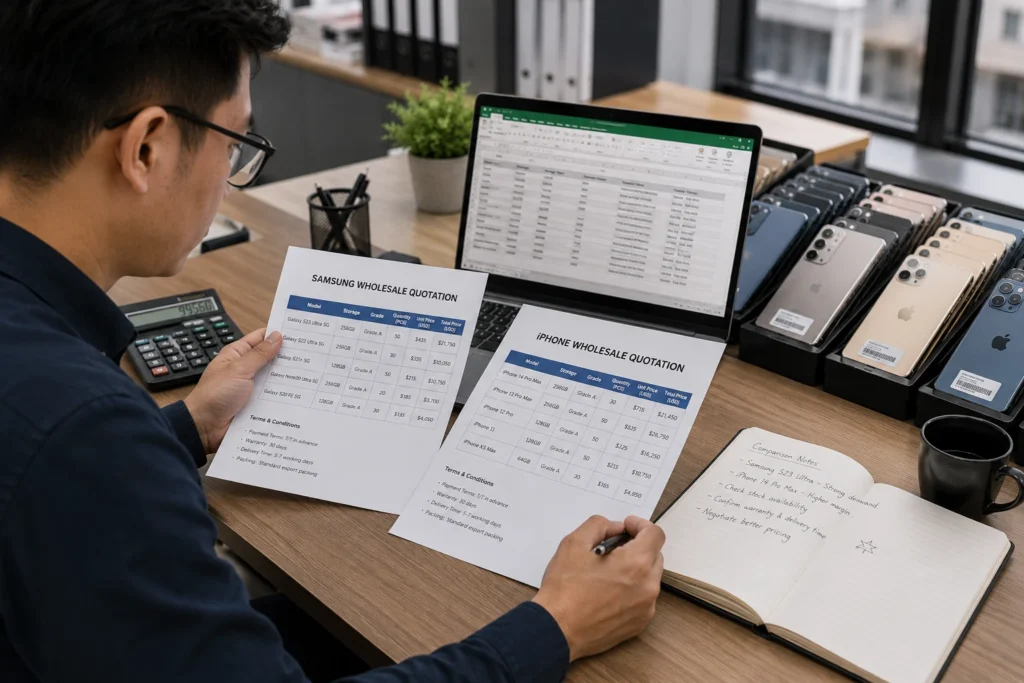
Working through this checklist before every new order, rather than only on the first purchase, helps buyers catch changes in supplier grading or regional demand before they affect a full shipment.
Building a Resale Catalog Based on Market Evidence
Deciding between used Samsung phones and used iPhones for resale is not about which brand is objectively better, but about which brand matches your market, budget tier, and repair infrastructure most closely. Buyers who apply brand-specific grading standards, verify battery health and IMEI status independently, and test regional demand with smaller trial orders consistently build more profitable and lower-risk inventory than those who source on assumption alone.
Not sure which models fit your market best?
Ask for Model Advice — INENG’s sourcing team can recommend the right Samsung and iPhone mix for your resale market, budget, and volume.
Frequently Asked Questions
Do used Samsung phones vs used iPhones resell faster overall?
When comparing used Samsung phones vs used iPhones, neither brand consistently resells faster in every market. Used iPhones wholesale inventory generally performs better in regions with strong Apple demand, while used Samsung phones wholesale stock often sells faster in price-sensitive markets due to its wider price range.
What is a reasonable battery health threshold for used iPhones wholesale orders?
Most wholesale buyers expect used iPhones wholesale devices to have a battery health of 80–85% or higher for Grade A and A+ stock. Lower battery health may be acceptable for lower grades if the price reflects the condition and the devices will be prepared as phones for resale.
How is battery condition verified for used Samsung phones wholesale if there is no battery health percentage?
Unlike iPhones, used Samsung phones wholesale devices do not display a standard battery health percentage. Suppliers typically verify battery condition using professional diagnostic tools that measure cycle count, voltage, and charging performance. Buyers should also inspect sample units before approving a bulk order.
Should I stock only one brand if my market clearly prefers it?
Even if your market strongly favors one brand, it is still wise to compare used Samsung phones vs used iPhones before purchasing inventory. Keeping a small quantity of the secondary brand can attract additional customers looking for different phones for resale and help increase overall sales.
Are grading standards the same across suppliers for used Samsung phones wholesale and used iPhones wholesale?
No. Grading standards can vary between suppliers. Buyers sourcing used Samsung phones wholesale or used iPhones wholesale should always request the supplier’s written grading criteria, sample photos, and inspection standards before placing an order.
What MOQ should I expect when testing a new supplier for used Samsung phones wholesale and used iPhones wholesale?
Many suppliers accept trial orders of 20–50 units per model when working with a new customer. Used iPhones wholesale models often have lower trial MOQs because of higher demand, while used Samsung phones wholesale quantities may vary depending on the Galaxy series.
Does IMEI verification work the same way for used Samsung phones vs used iPhones?
Yes. The IMEI verification process is important for both used Samsung phones vs used iPhones. Samsung devices should also be checked for Google FRP lock status, while iPhones must be verified for iCloud Activation Lock before they are sold as phones for resale.
How often should I re-evaluate my used Samsung phones vs used iPhones inventory mix?
Review your inventory performance at least once every quarter. Regularly comparing sales data for used Samsung phones vs used iPhones helps you adjust purchasing decisions and maintain the right mix of phones for resale based on market demand.