Buying used or refurbished iPhones in bulk from an overseas supplier carries one real risk that every experienced importer eventually runs into: receiving a shipment of phones that look acceptable in photos but fail once your own customers turn them on. Battery health that drops within weeks of resale, blacklisted IMEIs that block activation, and hidden screen, camera, or button defects are all expensive problems to discover after a container has already cleared customs and reached your warehouse.
This article explains, in practical detail, the used iPhone testing process we follow at INENG TECHNOLOGY CO., LIMITED before every unit is packed for export, so that as a buyer you know exactly what quality control stands behind the stock you are quoted, and can compare it confidently against any other supplier you are evaluating.
Why a Documented Used iPhone Testing Process Matters to Buyers
For sourcing managers, distributors, and store owners, the largest hidden cost in wholesale used-phone trading is rarely the unit price itself; it is the return rate that follows a poorly tested batch. A supplier who skips consistent used iPhone QC effectively pushes that risk downstream onto you, and eventually onto the end customer who bought the device from your shop or online store.
A transparent, well-documented testing process before shipment gives a buyer something that a quick visual check on a video call can never provide: predictable grading, so an A-grade unit from one shipment genuinely matches an A-grade unit from the next order; verifiable functionality, since every core component has been tested against a fixed checklist rather than assessed by eye; and a written record that can be referred back to if a dispute arises after the goods have arrived.
This is precisely the gap that refurbished iPhone quality control is designed to close. Refurbishing a used device is not simply a matter of cleaning the housing and repackaging it attractively for resale; it is a structured process of confirming that the device will continue to perform reliably for the next owner, under normal daily use, for a reasonable period after the sale. The remainder of this article sets out how we structure that process from the moment a device arrives at our facility through to the point it leaves as export-ready stock.
Our Used iPhone Testing Process, Step by Step
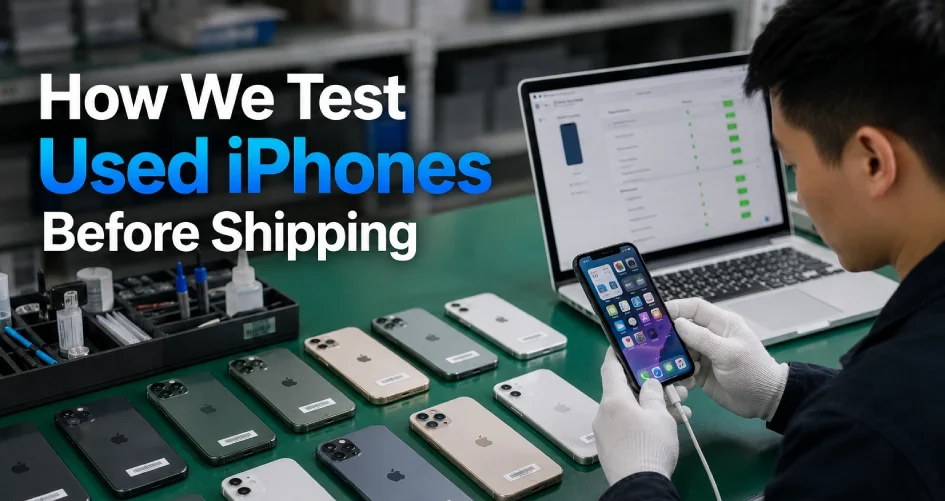
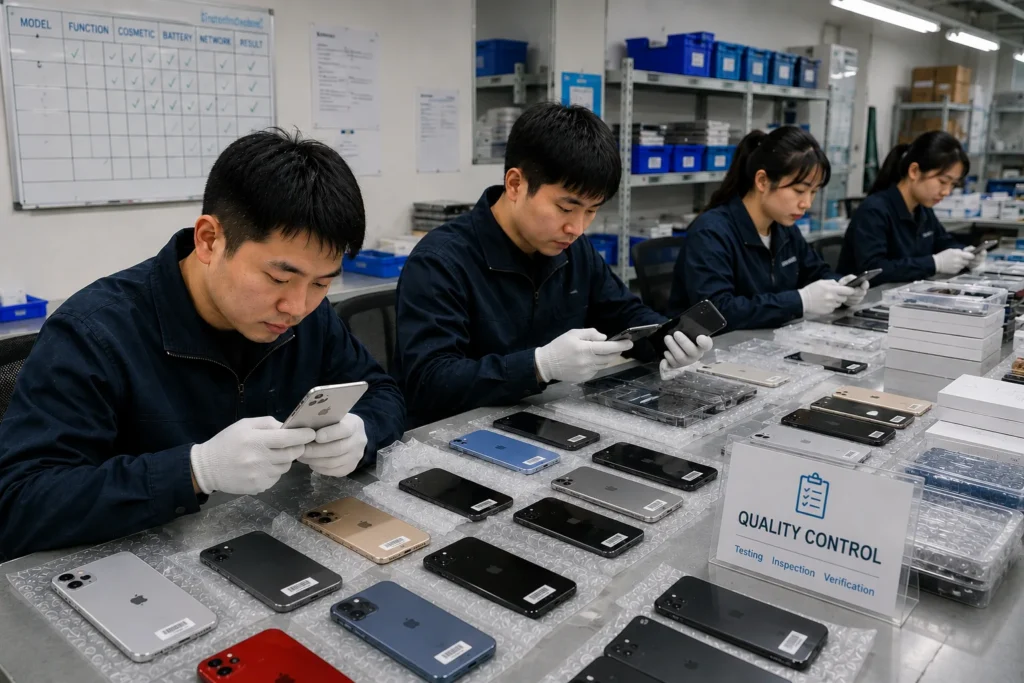
Every device that enters our warehouse moves through the same fixed sequence of checks, regardless of the quantity ordered or the destination market it is intended for. No unit is allowed to skip a stage, and no unit is packed for shipment until it has passed every stage relevant to the grade it will be sold under. The sections below describe each stage in the order it actually happens on our floor, so that you can picture how a phone moves from intake to export-ready inventory.
Intake Sorting and Model Verification
Each incoming iPhone is first scanned to confirm its model, storage capacity, and region lock against the supplier or trade-in manifest that accompanied it. This intake step matters more than buyers often assume, because mismatched or undeclared units are a common source of disputes further down the supply chain. Any device that does not match its paperwork is separated immediately and is never mixed into graded, sellable stock, which keeps the inventory you eventually order free from unexplained model or capacity discrepancies.
Visual and Cosmetic Grading
Once intake is confirmed, technicians inspect the front glass, back housing, metal frame, camera lens, and charging port under bright, angled lighting designed specifically to reveal micro-scratches, dents, and discoloration that ordinary phone-camera photography tends to miss entirely. This is the stage at which grade labels such as A, A+, B, and C are formally assigned, following the same written standard our team applies across every listing and every shipment, which you can review in more detail on our grading standards page before placing an order.
IMEI and Network Status Check
Every IMEI number is checked against GSMA and relevant carrier blacklist databases to confirm the unit has not been reported lost, stolen, or carrier-locked in a way that would prevent activation in your target market. We also verify that the device is not listed under any financing or installment blocklist, since these restrictions frequently cause activation failures even when the phone itself is in excellent physical and functional condition, a detail that a purely cosmetic inspection would never catch.
Battery Health Verification
Battery health is measured using diagnostic software that reports maximum capacity and total charge cycle count for each individual unit, not an average across the batch. A unit is only sold at full grade if it meets our minimum threshold, typically 85 percent capacity or above; anything below that threshold is either disclosed separately at a reduced grade or fitted with a new battery before resale, and is never shipped silently as full-grade stock. This single check resolves one of the most frequent complaints we hear from buyers who previously sourced from less rigorous suppliers.
Functional Testing of Core Components
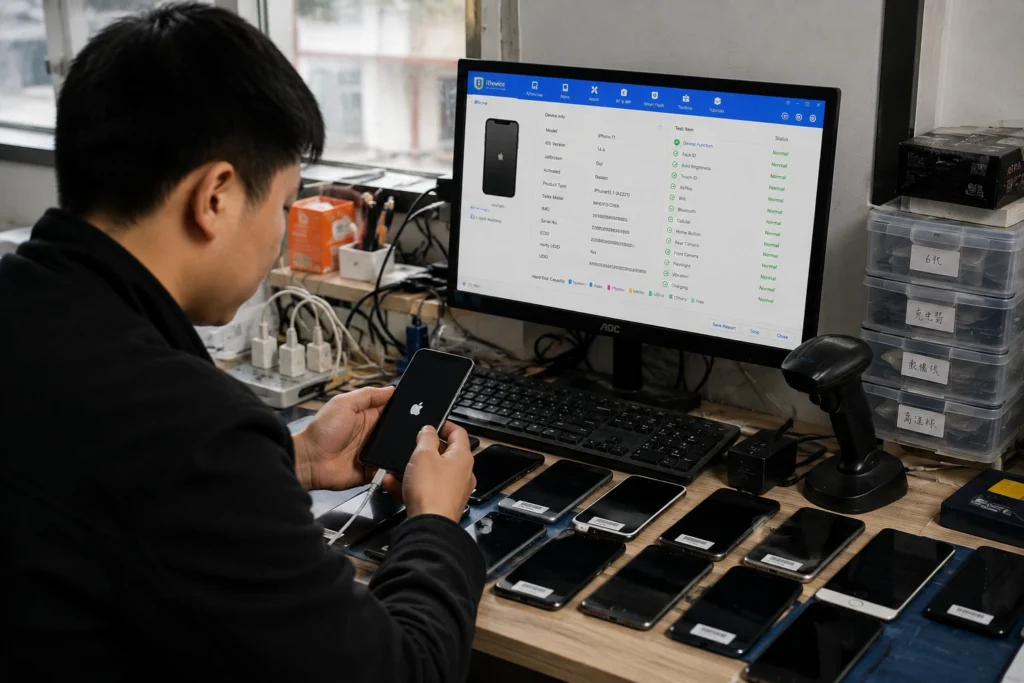
Functional testing is the most detailed stage of the entire used iPhone testing process, because it covers every component that a buyer’s own customer will actually rely on in daily use. Rather than describing each check as a list, the table below summarizes what is tested, the method used, and why it matters commercially to a wholesale buyer.
| Component Tested | Method Used | Why It Matters to Buyers |
| Touchscreen and display | Multi-touch grid test; screen checked for dead pixels, burn-in, and True Tone response | Prevents post-sale returns caused by unresponsive zones or visible display defects |
| Front and rear cameras, Face ID / Touch ID | Live capture test and biometric enrollment check | Confirms the device is fully usable for everyday photography and secure unlocking |
| Speakers, microphone, and wireless radios | Audio playback/record test; Wi-Fi and Bluetooth pairing test | Avoids complaints about call quality, audio distortion, or connectivity failures |
| Charging port and battery charging | Physical connector test plus charge-rate monitoring | Ensures the device charges at a normal rate without loose-connection issues |
| Buttons, mute switch, and vibration motor | Manual press-and-response verification | Confirms tactile controls function correctly before the unit reaches a retail shelf |
| SIM reader and network signal | SIM insertion test across supported network bands | Verifies the unit will register on local networks in the buyer’s destination country |
Table 1: Functional testing checklist applied to every unit during the used iPhone testing process.
Software Reset, Firmware Check, and Data Wipe
Once functional testing is complete, every unit is factory reset, Find My iPhone and Activation Lock status is confirmed to be switched off, and the firmware is verified as genuine, unmodified Apple software rather than a cloned or altered operating system. This step alone eliminates one of the most common disputes in the used and refurbished phone trade: a device that appears to work perfectly in testing but turns out to be locked to a previous owner’s Apple ID, a problem that typically only surfaces after the end customer has already purchased it.
Final QC Pass and Grade Confirmation
Before any unit is approved for packing, a second and independent technician re-checks both the assigned grade and the recorded test results. This second, independent pass is standard practice in any serious refurbished iPhone quality control program, and in our experience it catches the small percentage of cases where the first grading decision was borderline, ensuring that the grade printed on your invoice reflects the actual condition of the device inside the box.
Grading Standards and Testing Coverage by Grade
Before committing to a wholesale order, we recommend asking any supplier, including us, to confirm testing coverage against the table below. It sets out what should realistically be tested and disclosed at each grade level, and it is a useful reference to keep on hand whenever you are comparing quotations from different sourcing partners in China or elsewhere.
| Test Item | Grade A / A+ | Grade B | Grade C |
| IMEI blacklist check | Required | Required | Required |
| Battery health disclosed | 85% or above | 80–84%, disclosed | Below 80%, disclosed |
| Screen and touch function | Full test | Full test | Full test |
| Camera and Face/Touch ID | Full test | Full test | Full test, cosmetic wear allowed |
| Cosmetic condition | Minimal to no marks | Light scratches or marks | Visible wear, fully functional |
| Factory reset and Activation Lock check | Required | Required | Required |
| Original parts verification | Required | Required | Disclosed if replaced |
Table 2: Recommended testing coverage by grade for any used or refurbished iPhone order.
If a supplier is unable to explain clearly which of these checks apply to the specific grade you have been quoted, it is reasonable to treat that gap as a warning sign before placing a deposit, regardless of how attractive the headline price appears in the initial quotation.
Buyer Evaluation Table: Questions to Ask Before You Order
Many buyers find it useful to have a short evaluation framework on hand when comparing multiple suppliers side by side, rather than relying on memory during a negotiation call. The table below sets out six questions worth asking any supplier of used or refurbished iPhones, along with the reason each question matters and the answer you should expect from a supplier running a genuine used iPhone testing process.
| Question to Ask | Why It Matters | Answer to Expect |
| Do you test 100% of units, or only a sample batch? | Sample testing can miss defective units that ship undetected within a batch | 100% of units tested individually |
| Is battery health disclosed per unit? | Batch averages can hide individual units well below the stated threshold | Per-unit battery percentage on record |
| Is IMEI blacklist status checked before shipment? | Blacklisted or locked IMEIs may fail activation entirely in your market | Checked and available on request |
| Does grading follow a written standard? | Verbal grade descriptions vary between staff and between orders | Documented A/A+/B/C standard |
| Can you share test reports, photos, or video? | Visual and documentary proof reduces reliance on trust alone | Available for sample units or full batches |
| Is packaging designed for international freight? | Poor packaging can damage tested units before they even arrive | Anti-static, shock-resistant export packaging |
Table 3: Supplier evaluation questions for wholesale buyers of used and refurbished iPhones.
Common Mistakes Buyers Make When Sourcing Used iPhones
After working with wholesalers, distributors, and repair shop owners across multiple regions, we consistently see the same avoidable mistakes cost buyers money and time, often on their very first order with a new supplier. The paragraphs below describe each mistake in enough detail that you can recognize it in your own sourcing process before it becomes an expensive lesson.
Trusting Grade Labels Without Asking for the Testing Method Behind Them
A grade of A or A+ means very little on its own if the supplier has not clearly defined what testing sits behind that label. It is worth asking specifically what checks, covering battery health, IMEI status, and full functional testing, are actually performed for each grade before comparing prices between two or three competing suppliers. A cheaper A-grade quotation with little or no testing behind it is not actually a better deal; it simply shifts the cost of undiscovered defects onto you after the shipment arrives, at which point renegotiating with the original supplier becomes far more difficult.
Ignoring Battery Health Thresholds in Favor of Cosmetic Grade Alone
Many first-time buyers focus almost entirely on cosmetic grade and give battery health only a passing glance during negotiation, assuming that a phone which looks new will also perform like one. In practice, a cosmetically excellent phone with battery health in the low seventies will generate customer complaints within a month of resale, regardless of how clean the screen and housing look on delivery. It is worth requesting the minimum battery health guarantee in writing, per grade, before finalizing any order, so that expectations are aligned before payment is made rather than disputed afterward.
Skipping Independent IMEI Verification Before Final Payment
Some buyers rely solely on a supplier’s verbal assurance that units are unlocked and free of blacklist restrictions, without requesting any independent confirmation. Wherever possible, ask for the specific IMEI checking method used, and request a sample list of IMEIs from the batch so that you or a trusted partner can verify blacklist status independently before the final balance is paid. This single extra step, which typically takes less than a day, can prevent an entire shipment of otherwise functional phones from being unsellable in your target market.
Placing a Full Container Order Without a Sample Unit or Video Walkthrough
For first-time orders in particular, skipping a sample unit or a live video walkthrough of the testing process in order to save a few days of lead time often results in a full container of undiscovered issues surfacing only after the goods have cleared customs. A modest sample order, or a short video call showing the actual testing and packing process on the warehouse floor, is inexpensive insurance compared to the cost and delay of resolving a large-scale dispute after the fact.
Overlooking Export Packaging and Documentation Requirements
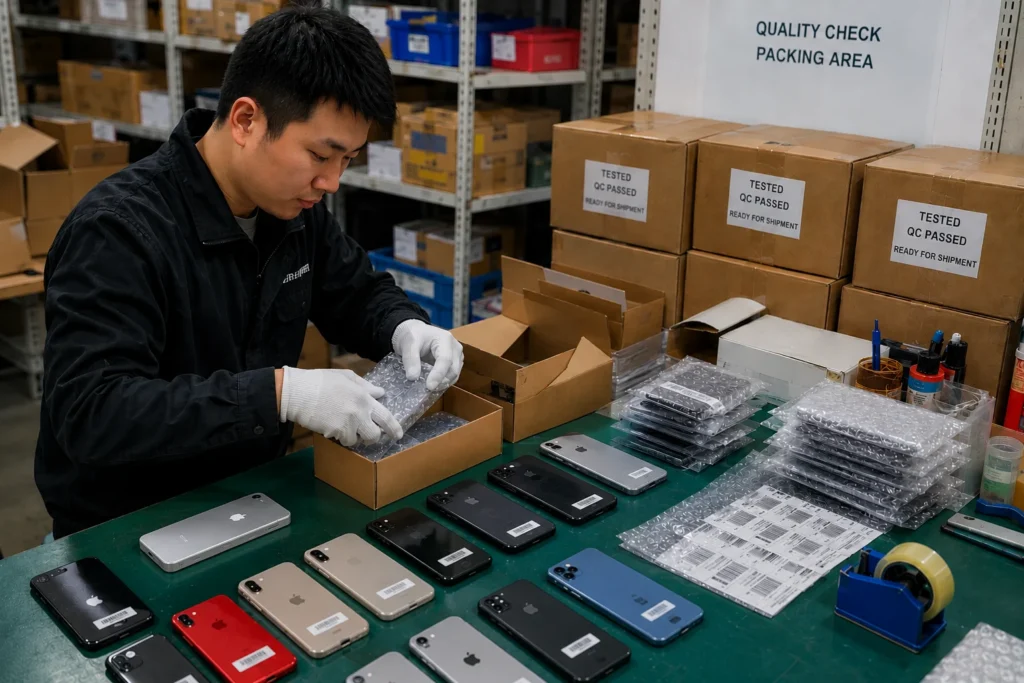
A phone that passes every stage of functional testing can still arrive damaged if the packaging used is not built to withstand long-distance freight handling and customs inspection procedures. It is worth confirming in advance that anti-static packaging, shock-resistant cartons, and correct labeling are a standard part of the process rather than an optional add-on charged separately, since packaging quality has a direct and measurable effect on the condition of units when they finally reach your warehouse.
From Testing to Export: Packaging and Documentation
Once a unit has passed final QC, it moves into a separate export preparation stage that is just as carefully controlled as the testing process itself. The table below summarizes the key steps involved in preparing tested stock for international shipment, so that you know what to expect between the completion of iPhone testing before shipment and the arrival of your order at port.
| Export Preparation Step | Purpose |
| Anti-static bagging and foam-padded inner packaging | Prevents transit damage and static discharge during handling and long-distance freight |
| Grade and IMEI labeling on each unit | Allows fast inventory reconciliation and grade verification when the shipment arrives |
| Carton-level packing lists matched to invoice data | Supports smooth customs clearance and reduces the risk of documentation disputes |
| Optional retail-ready packaging for e-commerce resale | Allows sellers to list units for direct-to-consumer sale without additional repackaging |
Table 4: Export preparation steps applied after testing and before shipment.
This is also the stage at which minimum order quantities, pricing tiers, and current tested stock availability are confirmed with the buyer, details you are welcome to review on our wholesale price list before requesting a formal quotation for your next order.
Request Tested Stock Today
A reliable used iPhone testing process is ultimately what separates a supplier relationship you can scale with confidence from one that generates constant disputes and costly returns. At INENG TECHNOLOGY CO., LIMITED, every unit is graded, battery-tested, IMEI-checked, and functionally verified before it is packed for export, and we are always glad to walk prospective buyers through the process on a call or share sample test reports before you commit to an order. Reach out to Request Tested Stock now to receive current availability, full grading details, and a quotation matched to your target markets.
Frequently Asked Questions
How many units do you test before shipment, all of them or a sample?
Every single unit goes through our complete used iPhone testing process and iPhone testing before shipment procedures; we do not rely on sample-batch testing for wholesale orders, regardless of order size.
What battery health percentage do you guarantee for Grade A units?
As part of our used iPhone QC standards, Grade A and A+ units are guaranteed at 85% battery health or above at the time of testing. Any device below that threshold is clearly disclosed and priced separately rather than being sold as a full-grade unit.
Can you provide proof of IMEI checks before I pay the balance?
Yes. During our refurbished iPhone quality control process, we can provide IMEI blacklist check results for sample units from your order before the final payment is confirmed, giving you additional confidence before shipment.
Do you offer video verification of the testing process itself?
Yes. We can arrange a live video walkthrough of our used iPhone testing process and used iPhone QC procedures for first-time buyers or larger wholesale orders, allowing you to see the inspection and packing process in real time.
What happens if a unit fails testing after I have already ordered a batch?
During iPhone testing before shipment, any device that fails functional testing, IMEI verification, battery health requirements, or cosmetic inspection is removed from graded inventory. As part of our refurbished iPhone quality control policy, it is repaired, downgraded with full disclosure, or excluded from the shipment entirely.
Is Activation Lock or Find My iPhone status checked on every unit?
Yes. Checking Activation Lock and Find My iPhone status is a mandatory step in our used iPhone testing process. No device passes our used iPhone QC standards or is approved for shipment with Activation Lock enabled.
What is your minimum order quantity for tested used or refurbished iPhones?
Minimum order quantities vary by model and grade. All devices undergo our refurbished iPhone quality control and iPhone testing before shipment procedures before dispatch. Contact us for a wholesale quotation tailored to your target market and volume requirements.