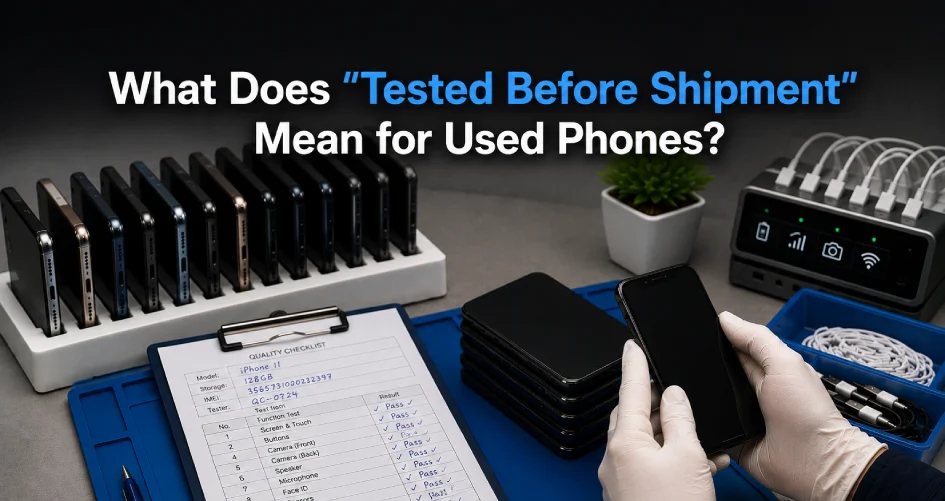
“Fully tested before shipment” appears on almost every wholesale used phone listing, yet the phrase means very different things depending on the supplier. Some sellers run a full diagnostic covering battery, screen, camera, and network functions, while others simply power the device on and check that it boots. For overseas importers, distributors, and phone store owners, this gap creates real financial risk once a container arrives and units fail functions that were never actually checked. This guide breaks down exactly what tested used phones wholesale should include, how a proper used phone QC process works step by step, and how to confirm refurbished phone testing claims before you commit to a purchase order.
Why “Tested Before Shipment” Is the Most Misunderstood Claim in Sourcing
The phrase “tested before shipment” carries no fixed industry definition, which means two suppliers can use identical wording while offering completely different levels of quality assurance. One factory may test twenty or more functions on every unit, while another may only confirm that the phone powers on and displays a home screen before boxing it. Buyers who assume the phrase always means the same thing often discover the difference only after receiving a shipment with dead pixels, faulty microphones, or SIM cards that will not register on a local network.
This ambiguity is exactly why serious sourcing managers ask suppliers to define their testing scope in writing rather than relying on marketing language on a product listing. A supplier confident in their process will happily share a documented checklist, and many, including INENG Technology, will provide sample testing videos or reports for review before an order is placed. Treating “tested” as a specific, verifiable claim rather than a general assurance is the single biggest shift that protects buyers from costly returns and disputes after the container has already left port.
What a Real Used Phone QC Process Actually Covers
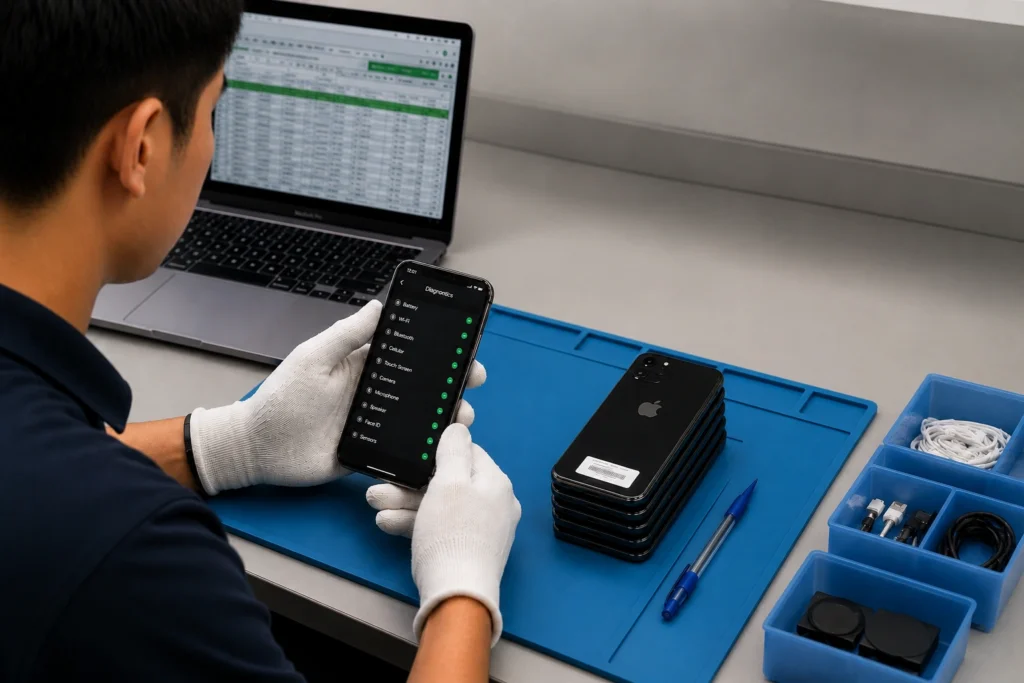
A complete used phone QC process is built around functional categories rather than a single pass or fail check, since a device can work perfectly in one area while failing in another. At INENG Technology, every unit moves through battery, display, camera, audio, sensor, and network testing stages before it is approved for wholesale packing, and each stage is logged so buyers can request the underlying data for their order. Below is a breakdown of what each testing category should realistically include so you can compare it against any supplier’s stated process.
| Test Category | What Is Checked | Why It Matters to Buyers |
| Battery | Health percentage, charging speed, cycle count | Prevents early battery failure and return claims |
| Display | Touch response, dead pixels, screen burn-in | Screen defects are the most common resale complaint |
| Camera | Front and rear focus, flash, video recording | Camera issues are hard to detect without active testing |
| Audio | Speaker, microphone, earpiece clarity | Call quality issues directly affect end-user satisfaction |
| Network | SIM recognition, Wi-Fi, Bluetooth, cellular signal | Confirms the device will function on your target market’s carriers |
Battery and Charging Tests
Battery testing confirms both the stored health percentage and real charging behavior under load, since a battery can display an acceptable percentage while still charging unusually slowly due to a faulty charging port or controller. This stage is closely tied to the battery health verification process we cover in detail in our dedicated battery health guide, and buyers sourcing battery-sensitive stock should review both resources together before placing a large order.
Screen, Touch, and Display Tests
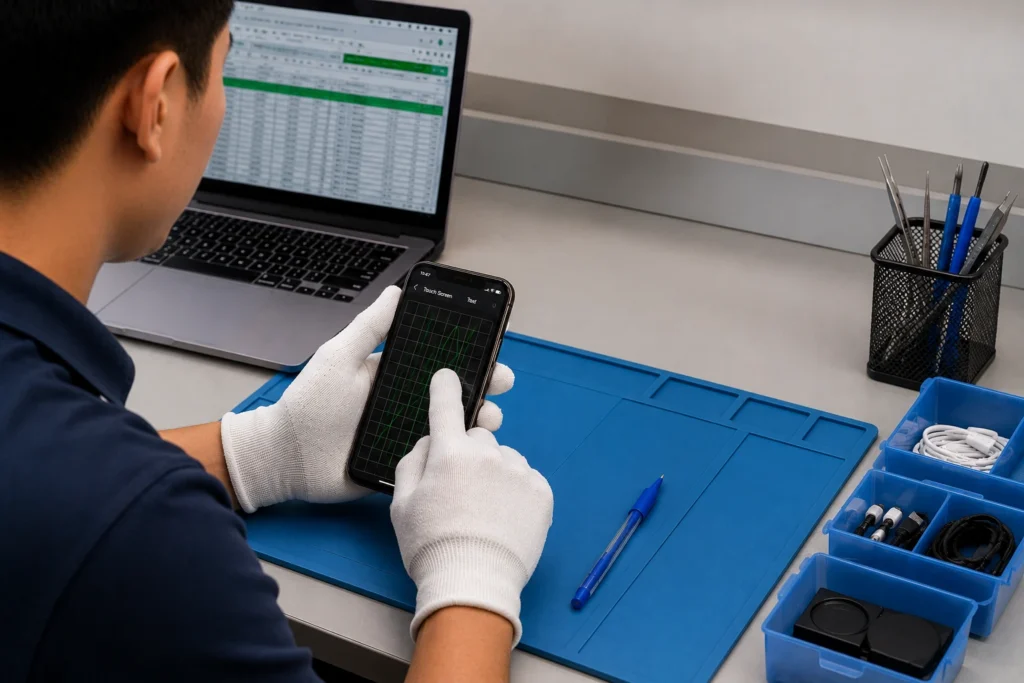
Every panel is tested for uniform touch response across the full screen surface, color accuracy, and visible defects such as dead pixels, discoloration, or burn-in on OLED models. Touch testing is performed using grid-pattern software that highlights unresponsive zones a technician might otherwise miss during a simple visual inspection, which is a meaningful step beyond the basic power-on check some lower-cost suppliers rely on.
Camera, Speaker, and Sensor Tests
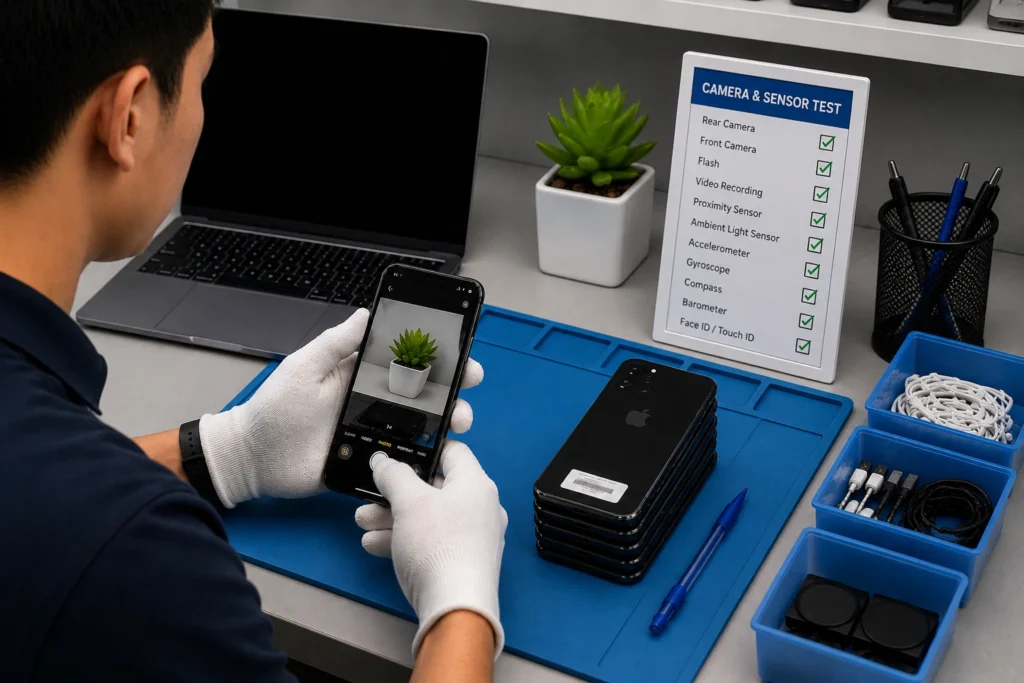
Camera testing covers focus accuracy, flash function, and video recording on both front and rear lenses, since autofocus issues are rarely visible without capturing an actual photo or video during inspection. Speaker, microphone, and earpiece testing confirm call and media audio quality, while sensor checks verify proximity, accelerometer, and fingerprint or Face ID function where applicable to the model being tested.
Network, SIM, and Connectivity Tests
Each device is tested with an active SIM card to confirm cellular signal registration, along with separate checks for Wi-Fi and Bluetooth connectivity. This step is particularly important for buyers importing into regions with specific carrier band requirements, since a phone that tests perfectly on one network can still fail to register on another if band compatibility was not verified before shipment.
IMEI and Software Verification Before Packing
Functional testing alone does not confirm that a device is safe to resell, which is why IMEI verification runs alongside every physical test in a proper used phone QC process. Each IMEI is checked against blacklist and lost-or-stolen databases, and the device is confirmed to be free of any iCloud, Google, or carrier account lock that would prevent activation for the end customer. Skipping this step is one of the fastest ways a wholesale buyer ends up with unsellable inventory sitting in a warehouse.
Software resets are equally important: every unit is restored to factory settings and updated to a stable operating system version before packing, removing any previous user data, personal accounts, or configuration profiles. This ensures the device arrives ready for activation in your market rather than requiring additional setup work on your end, which saves labor cost and reduces the risk of accidentally reselling a phone still linked to a previous owner’s account.
Refurbished Phone Testing vs Basic Power-On Checks
Not all testing is created equal, and understanding the gap between a full refurbished phone testing process and a basic power-on check helps buyers evaluate supplier quotations more accurately. A lower price often reflects a shorter testing process, so comparing quotes without accounting for testing depth can lead to a false sense of savings once return rates and customer complaints are factored in.
| Testing Element | Basic Power-On Check | Full Refurbished Phone Testing |
| Battery health reading | Rarely checked | Percentage, cycle count, and charging speed logged |
| Touch screen accuracy | Visual check only | Grid-pattern software test across full screen |
| Camera function | Not tested | Photo and video capture on front and rear lenses |
| Network registration | Not tested | Active SIM test for cellular, Wi-Fi, and Bluetooth |
| IMEI and lock status | Sometimes skipped | Verified against blacklist and account lock databases |
| Documentation provided | None or minimal | Test report and optional testing video per unit or batch |
Buyers do not need to guess which category a supplier falls into, since the testing elements listed above can be requested directly in a pre-order questionnaire. Asking a supplier to confirm, in writing, which of these specific checks are included removes the ambiguity that vague marketing phrases like “fully tested” tend to create, and it gives you a clear basis for comparison across multiple quotations.
Buyer Checklist to Confirm Testing Coverage Before Order
Before approving a purchase order, it is worth working through a short checklist with your supplier to confirm exactly what tested used phones wholesale means for your specific shipment. The table below lists the core questions that separate a supplier with a genuine used phone QC process from one relying on vague claims, along with why each question matters to your bottom line.
| Checklist Question | Why It Matters |
| Which specific functions are tested on every unit? | Confirms scope beyond a basic power-on check |
| Is testing done per unit or on a batch sample only? | Per-unit testing catches issues batch sampling can miss |
| Can I receive a testing video before final payment? | Provides independent, verifiable proof of condition |
| Is IMEI checked against blacklist and lock databases? | Prevents receiving unsellable or locked devices |
| What is the process if a tested unit fails after arrival? | Establishes replacement or refund terms in advance |
| Are test results logged per device or estimated? | Logged results allow you to trace issues back to specific units |
Common Mistakes Buyers Make When Trusting “Tested” Claims
Accepting “Tested” Without Asking What Was Actually Checked
The word “tested” on its own carries no specific meaning, and buyers who accept it at face value often assume a full diagnostic process was used when only a basic power-on check occurred. Always ask for a written list of exactly which functions were tested, since a supplier unwilling or unable to provide this detail is a warning sign worth taking seriously before you commit to a purchase order.
Skipping Testing Video Requests to Save Time
Buyers under time pressure sometimes skip requesting a testing video to speed up the ordering process, only to find themselves without any documentation when a dispute arises later. Requesting even a short sample video adds minimal delay to the sourcing timeline but provides a level of proof that a written report alone cannot match, particularly for first-time orders with a new supplier.
Assuming All Grades Receive the Same Testing Depth
Some buyers assume that lower-graded, budget-priced units receive the same testing depth as premium grades, which is not always accurate across every supplier. It is worth confirming directly whether refurbished phone testing procedures are consistent across all grades in your order, or whether lower grades receive a reduced testing scope that should be reflected in your pricing and warranty expectations.
Not Cross-Checking Test Reports Against Physical Units on Arrival
Even with a detailed test report in hand, some buyers skip verifying a sample of received units against that documentation once the shipment arrives. Spot-checking IMEI numbers, battery percentages, and basic functions against the supplied report helps catch any discrepancy early, while the shipment is still within any agreed inspection window rather than after it has already been distributed to retail customers.
Overlooking Software and Lock Status Testing
Buyers often focus heavily on hardware condition, such as screen and battery, while giving less attention to confirming that every unit is free of iCloud, Google, or carrier locks. A phone can pass every hardware test perfectly and still be completely unsellable if it remains linked to a previous owner’s account, so lock status verification deserves the same attention as physical testing in your QC questions.
Requesting Testing Videos and Reports
The most reliable way to confirm that used phones tested before shipment claims are accurate is to request video documentation of the actual testing process rather than relying on a written summary alone. A short video showing diagnostic software results, camera capture tests, and network registration for sample units gives buyers visual proof that matches the specifications listed in the quotation, and it is a service INENG Technology provides on request for both trial and bulk orders.
For larger container orders, it is reasonable to request batch-level testing videos covering a representative sample from each grade, along with a spreadsheet listing IMEI, battery health, and test results for every unit. This documentation becomes especially valuable if a dispute arises after arrival, since it gives both the buyer and supplier a clear, timestamped record of the condition each device was in immediately before packing and shipment.

INENG Technology tests every unit across battery, display, camera, audio, sensor, and network categories, backed by IMEI verification and detailed documentation available on request. If you want to see exactly what tested used phones wholesale looks like before committing to your next order, our team can share sample testing videos and reports for the grades and models you are sourcing.
Contact INENG Technology Co., Limited to receive sample testing videos and QC reports for your next wholesale order.
Frequently Asked Questions
What does “tested before shipment” actually include?
For INENG Technology, used phones tested before shipment undergo battery, display, camera, audio, sensor, and network testing, along with IMEI and software lock verification, before every device is approved for packing.
Is every unit tested individually, or just a sample?
Every device is tested individually as part of our used phone QC process, and the results are logged per unit so buyers can request device-level testing records for their order.
Can I request a testing video before paying for my order?
Yes. We can provide sample testing videos showing diagnostic results, camera performance, and network registration so buyers can verify our refurbished phone testing process before confirming a bulk purchase.
How is refurbished phone testing different from a basic power-on check?
A basic check only confirms the device powers on, while refurbished phone testing verifies battery health, display accuracy, camera performance, audio, sensors, and network connectivity to ensure the phone is fully functional.
Do all grades receive the same level of testing?
Yes. All tested used phones wholesale orders receive the same comprehensive functional testing. Grade differences relate only to cosmetic condition and battery health thresholds, not to reduced testing coverage.
What happens if a tested unit fails after it arrives?
Buyers should document the issue with photos or diagnostic screenshots so it can be reviewed against the original used phone QC process records and resolved according to the agreed order terms.
Does testing include IMEI and lock status verification?
Yes. Every device in our tested used phones wholesale inventory is checked against blacklist and lost-or-stolen databases, and confirmed free of iCloud, Google, or carrier account locks before shipment.