
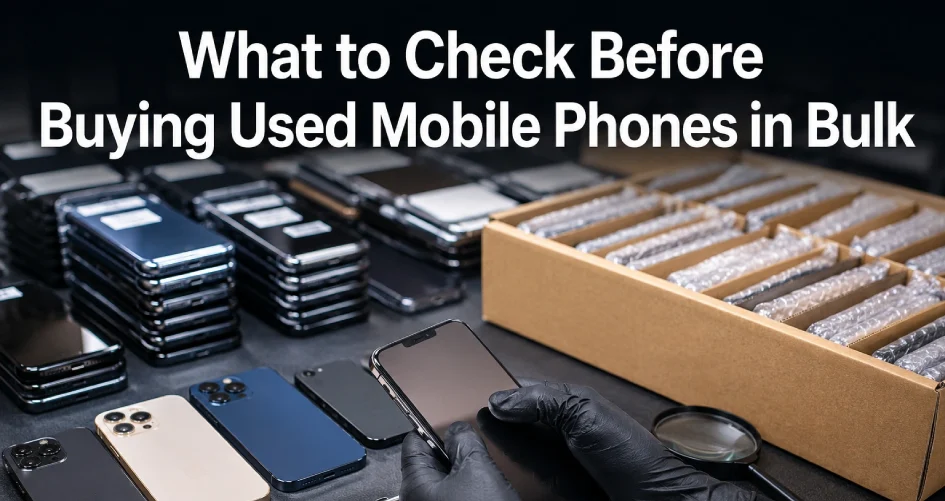
Buying used mobile phones in bulk without a proper inspection process is one of the fastest ways for wholesalers, importers, and resellers to lose money on grading disputes, dead batteries, or blacklisted IMEIs. A single bad used phones bulk order can tie up capital, damage customer trust, and delay resale. This guide walks you through exactly what to verify — supplier credentials, grading standards, battery health, IMEI status, functional testing, pricing, and export packaging — so you can place your next wholesale used mobile phones order with confidence and fewer surprises at unboxing.
Why a Pre-Purchase Checklist Matters When Buying Used Mobile Phones in Bulk
Unlike buying a single second-hand handset, a bulk purchase multiplies both the opportunity and the risk. A grading error on one unit is an inconvenience; the same error across a pallet of 500 units is a financial problem. International buyers also face added friction — language barriers, time-zone delays, and the inability to physically inspect stock before it ships. A written checklist turns a subjective, trust-based transaction into a measurable, repeatable process that protects your margin on every order, whether you’re sourcing 50 units for a repair shop or 5,000 units for a regional distribution network.
The sections below cover each stage of due diligence in the order most experienced buyers apply it: supplier vetting, grading, battery and IMEI verification, functional testing, commercial terms, and export logistics.
Supplier Selection: Vetting Your Wholesale Used Mobile Phones Partner
Your supplier is the single biggest variable in the transaction. A trustworthy wholesale used mobile phones supplier will be transparent about sourcing, testing, and grading long before you send a deposit.
Verify Business Licenses and Export Experience
- Ask for a business license, export license, and company registration documents.
- Request references from existing overseas clients in your region, ideally in a similar industry (repair, retail, e-commerce).
- Check how many years the supplier has exported used and refurbished phones, not just sold domestically.
Ask About Warehouse Visits and Live Video Inspection
- Reputable suppliers welcome in-person warehouse visits or offer a live video call to walk through current stock.
- Ask whether testing and grading happen in-house or are outsourced — in-house control usually means faster turnaround and more consistent grading.
- Confirm the supplier can provide sample units or a small trial order before you commit to a full container or pallet.
Grading Standards: Know What You’re Actually Buying
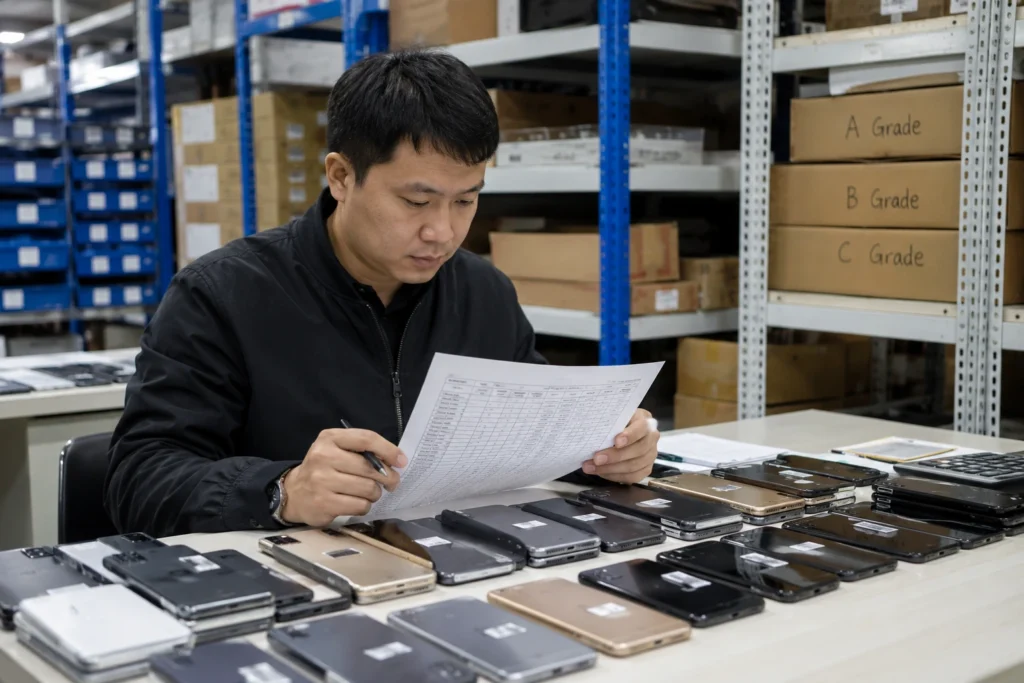
Grading terminology is not universally standardized, so the same label — “Grade A” — can mean different things from one supplier to the next. Before you buy used mobile phones in bulk, ask for the supplier’s written grading definitions and, ideally, reference photos for each grade.
| Grade | Screen Condition | Body Condition | Typical Use Case |
| A+ (Like New) | No visible scratches | Minimal to no signs of use | Premium resale, retail display |
| A (Excellent) | Light micro-scratches, not visible when screen is on | Minor edge wear | Standard retail resale |
| B (Good) | Visible light scratches | Noticeable wear, dents possible | Value resale, bundle deals |
| C (Fair) | Scratches or minor cracks may be present | Heavier wear, cosmetic damage | Budget resale, parts/repair stock |
Battery Health Verification Before Bulk Purchase
Battery condition is one of the most common sources of buyer complaints after a bulk purchase, and it is also one of the easiest things to verify upfront if you ask the right questions.
- Request the minimum battery health percentage guaranteed per unit (Industry norm for graded stock is 85% or higher for Grade A and 80% or higher for Grade B).
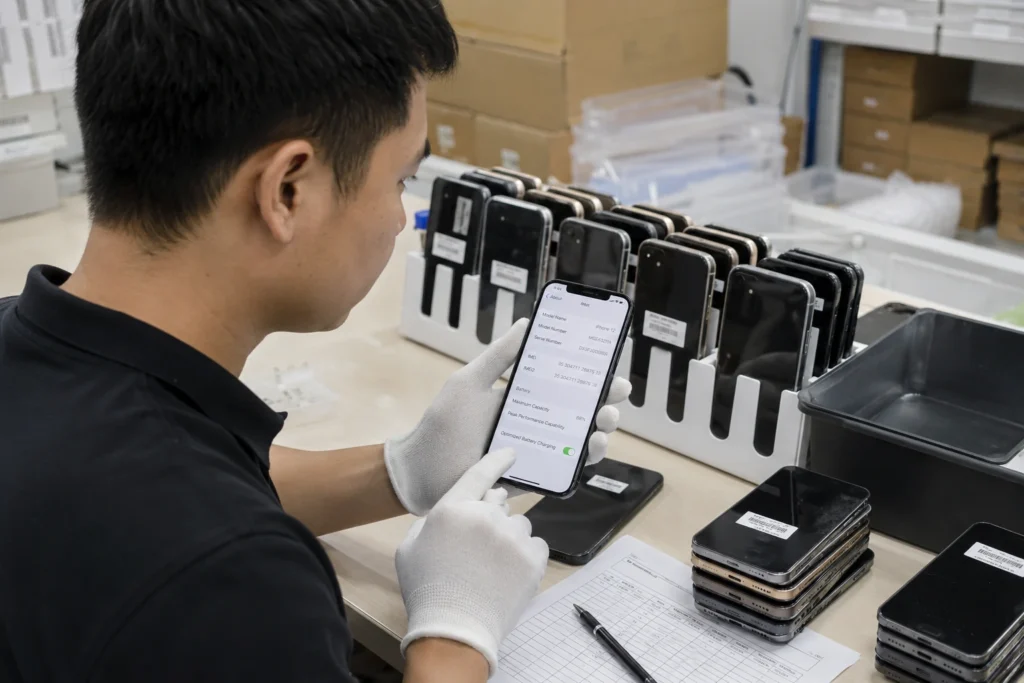
- Ask whether battery health is measured using diagnostic software (such as built-in iOS battery health tools or third-party testing tools) and request sample screenshots or reports.
- Clarify whether batteries are original or replaced, and if replaced, whether they are original-grade or aftermarket.
- Confirm the supplier’s policy on units that fall below the agreed battery health threshold — replacement, credit, or refund.
IMEI Checks and Blacklist Verification
An IMEI check protects you from receiving stolen, blacklisted, or carrier-locked devices that cannot be legally resold or activated in your market. This step should never be skipped, regardless of how long you’ve worked with a supplier.
- Request the full IMEI list for the order before shipment so you can run an independent blacklist and carrier-lock check.
- Confirm devices are unlocked (or carrier-matched to your target market if you specifically need locked units).
- Ask the supplier to guarantee clean IMEI status in the sales contract, with a replacement clause for any unit that fails verification after delivery.
- For large used phones bulk orders, consider requesting a random-sample IMEI audit via video call before the shipment is sealed.
Functional Testing and Quality Control on Every Unit
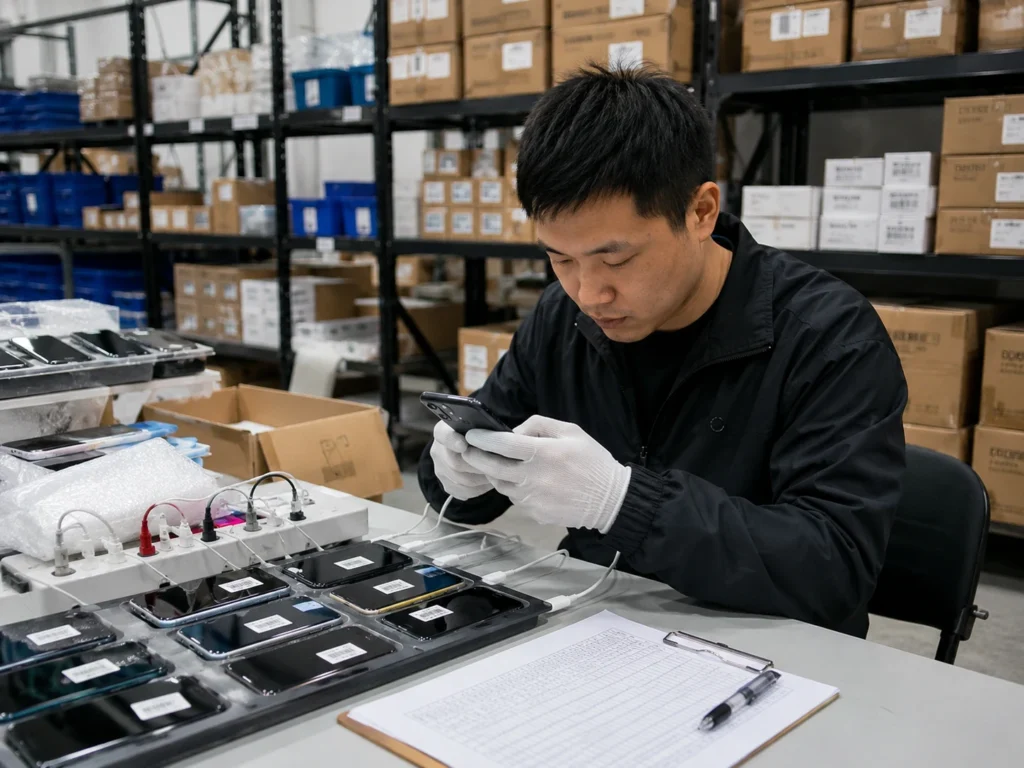
A rigorous used phone inspection process should test far more than whether a device powers on. Ask your supplier to confirm — ideally in a written QC report — that every unit passes multi-point functional testing before packing.
- Touchscreen response, display uniformity, and dead-pixel check
- Front and rear camera, flash, and autofocus function
- Speaker, microphone, and headphone jack (if applicable)
- Wi-Fi, Bluetooth, GPS, and cellular signal function
- Charging port, wireless charging (if applicable), and fast-charge function
- Buttons, sensors (fingerprint/Face ID), and vibration motor
- Water damage indicator status and internal corrosion check
Ask whether the supplier performs 100% unit-level testing or spot-checks a percentage of each batch. For a used phones bulk order, 100% testing with a digital QC report attached to each unit or carton is the standard to look for.
MOQ, Pricing, Quotations, Stock Availability, and Export Preparation
Once quality standards are confirmed, align on commercial terms so pricing and delivery timelines match your resale plan.
Stock Availability and MOQ
- Ask for real-time stock availability by model, grade, storage capacity, and color — not just total unit counts.
- Confirm minimum order quantity (MOQ) per model versus per overall order; many suppliers allow mixed-model containers above a combined MOQ.
Pricing and Quotations
- Request an itemized quotation broken down by model, grade, and unit price, not a single lump-sum figure.
- Clarify what the quoted price includes: testing, grading, packaging, and whether shipping/insurance is FOB, CIF, or EXW.
- Ask about price protection or renegotiation terms if market prices shift significantly between quotation and shipment.
Packaging, Shipping, and Export Documentation
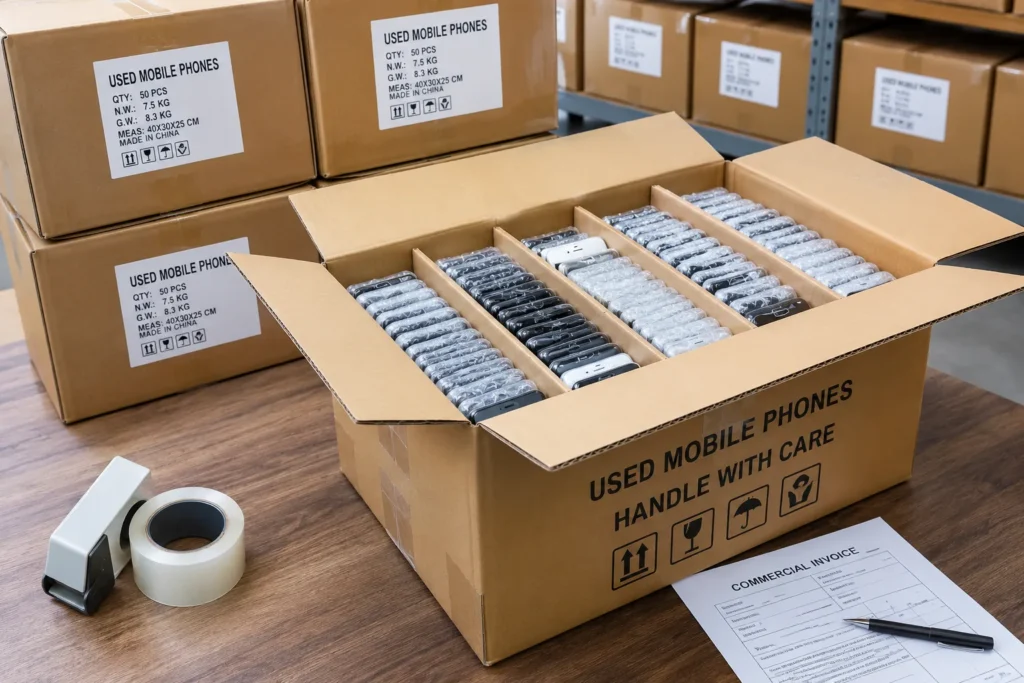
- Confirm anti-static packaging or individual poly-bagging per unit to prevent scratches and static damage in transit.
- Ask for carton-level labeling with model, grade, IMEI range, and quantity for faster customs clearance and warehouse receiving.
- Request export documentation in advance: commercial invoice, packing list, and any certificates required for used-electronics import in your country.
- Discuss cargo insurance options for high-value bulk shipments.
Pre-Purchase Checklist: What to Confirm Before You Pay
Use this quick-reference checklist as your final gate before releasing payment on a used phones bulk order.
| Checklist Item | Confirmed? |
| Business license and export history verified | ☐ |
| Sample order or warehouse/video inspection completed | ☐ |
| Written grading standard with reference photos received | ☐ |
| Minimum battery health percentage guaranteed in writing | ☐ |
| Full IMEI list provided and blacklist-checked | ☐ |
| Functional QC report per unit or per batch received | ☐ |
| Itemized quotation by model, grade, and quantity | ☐ |
| MOQ, payment terms, and lead time confirmed | ☐ |
| Packaging and carton labeling standard confirmed | ☐ |
| Export documents and insurance terms agreed | ☐ |
Common Mistakes to Avoid When Buying Used Mobile Phones in Bulk
Skipping the Sample Order
Buyers eager to lock in a low price often go straight to a full container order. Without a small trial batch first, you have no benchmark to judge whether the full shipment matches the agreed grading and battery standards. A sample order of 20–50 units is a small cost relative to the risk it removes.
Accepting Verbal Grading Promises Without Documentation
“Grade A” means nothing without a written, photo-referenced definition attached to your purchase contract. Verbal assurances are unenforceable if a dispute arises after the shipment lands. Always get grading criteria, battery health minimums, and IMEI guarantees in writing.
Ignoring IMEI and Blacklist Verification
Some buyers assume that because a phone powers on and looks clean, it is automatically legitimate. Blacklisted or stolen IMEIs can result in devices being blocked by carriers after import, leaving you with unsellable inventory and no recourse if this wasn’t checked before shipment.
Focusing Only on Unit Price
The lowest quoted price per unit is not always the lowest total cost. A supplier offering a cheaper price but weaker QC, inconsistent grading, or slower replacement policies can cost more in returns, refunds, and reputation damage than a slightly higher-priced, better-vetted supplier.
Underestimating Packaging and Shipping Requirements
Poor packaging leads to scratched screens, cracked frames, and static damage that turn Grade A stock into Grade B or C by the time it arrives. Confirm packaging standards and, for high-value shipments, cargo insurance before the order ships — not after damage is discovered.
Buy With a Process, Not Just a Price
Buying used mobile phones in bulk successfully comes down to process, not luck. Suppliers who welcome inspection, provide written grading and battery guarantees, share full IMEI data, and document functional testing are signaling that they expect to be checked — and that they’ll stand behind what they sell. Buyers who apply the checklist above consistently reduce disputes, protect margins, and build repeatable, scalable sourcing relationships instead of one-off gambles.
INENG TECHNOLOGY CO., LIMITED supplies graded, tested wholesale used mobile phones to importers, distributors, resellers, and repair businesses worldwide, with transparent grading, battery health guarantees, verified IMEI records, and export-ready packaging on every used phones bulk order.
Ready to place your next bulk order?
Contact Us— Request current stock availability, grading samples, and a customized quotation from INENG TECHNOLOGY CO., LIMITED today. Our sourcing specialists will recommend the most suitable grading options based on your business needs and target market. Receive competitive wholesale pricing, flexible order quantities, and detailed product specifications for your inquiry. Contact us today to discuss your requirements and secure reliable, export-ready used mobile phones from a trusted supplier.
Frequently Asked Questions
What should I check before buying used mobile phones in bulk?
Before buying used mobile phones in bulk, verify the supplier’s grading standard, battery health, IMEI status, cosmetic condition, and functional testing reports. A thorough used phone inspection helps ensure the devices match your quality expectations before placing a large order.
What is a reasonable MOQ for a used phones bulk order?
MOQs for a used phones bulk order vary by supplier and model popularity, but many wholesale used mobile phones suppliers require between 50 and 100 units for a single model. Some suppliers also offer lower MOQs when you mix multiple models in one shipment. Always confirm whether the MOQ applies per model or per total order.
How do I verify battery health before buying used mobile phones in bulk?
When buying used mobile phones in bulk, request a diagnostic report or screenshots showing the battery health percentage for sample units. Agree on a minimum guaranteed battery health—commonly 80% or higher—and include it in your purchase contract before payment. This is an important part of any professional used phone inspection process.
Can I get an IMEI list before the shipment is sent?
Yes. Reputable wholesale used mobile phones suppliers can provide a complete IMEI list before shipment, allowing you to perform an independent blacklist and lock-status check. Verifying IMEIs should be a standard step in every used phone inspection before accepting a used phones bulk order.
What grading standard should I ask for?
Ask your wholesale used mobile phones supplier for a written grading standard with reference photos for each grade (A+, A, B, and C), rather than relying on generic industry terminology. Since grading definitions vary between suppliers, written documentation helps avoid misunderstandings when buying used mobile phones in bulk.
Is a sample order really necessary if I trust the supplier?
Yes. Even if you trust the supplier, product batches can vary over time. Placing a small sample order allows you to complete a proper used phone inspection, verify grading consistency, battery health, and overall device quality before committing to a larger used phones bulk order.
What shipping terms are common for wholesale used mobile phones?
FOB, CIF, and EXW are the most common shipping terms for wholesale used mobile phones. FOB and CIF are often preferred by international buyers because the supplier manages export logistics up to the port or destination port, while EXW requires the buyer to arrange most transportation and export handling.
How can I reduce import risk on a large used phones bulk order?
To reduce risk when buying used mobile phones in bulk, combine a sample order, written grading and battery guarantees, independent IMEI verification, a detailed used phone inspection, and cargo insurance. These steps help minimize disputes and protect your investment when purchasing wholesale used mobile phones internationally.