

A used phone wholesale stock list looks simple until an order goes wrong. Short codes, vague grades, and missing battery data can hide big gaps in condition, price, and risk. For overseas importers, distributors, resellers, and phone shop owners, one misread column can mean thin margins or unsold stock. This guide shows how to read the model, grade, storage, battery, MOQ, and price columns in a used iPhone stock list, so you can compare suppliers and request quotes with confidence.
What Does a Used Phone Wholesale Stock List Show?
A stock list is a live snapshot of available inventory
A used phone wholesale stock list is a supplier’s current inventory sheet, usually shared as an Excel file, PDF, or messaging attachment. Each row describes one lot of phones with a model, grade, storage size, battery condition, available quantity, and price. Unlike a catalogue, it changes daily as units sell, arrive, or are re-graded. Buyers should treat every list as a snapshot that must be confirmed before payment.
Six core columns decide whether a row is worth quoting
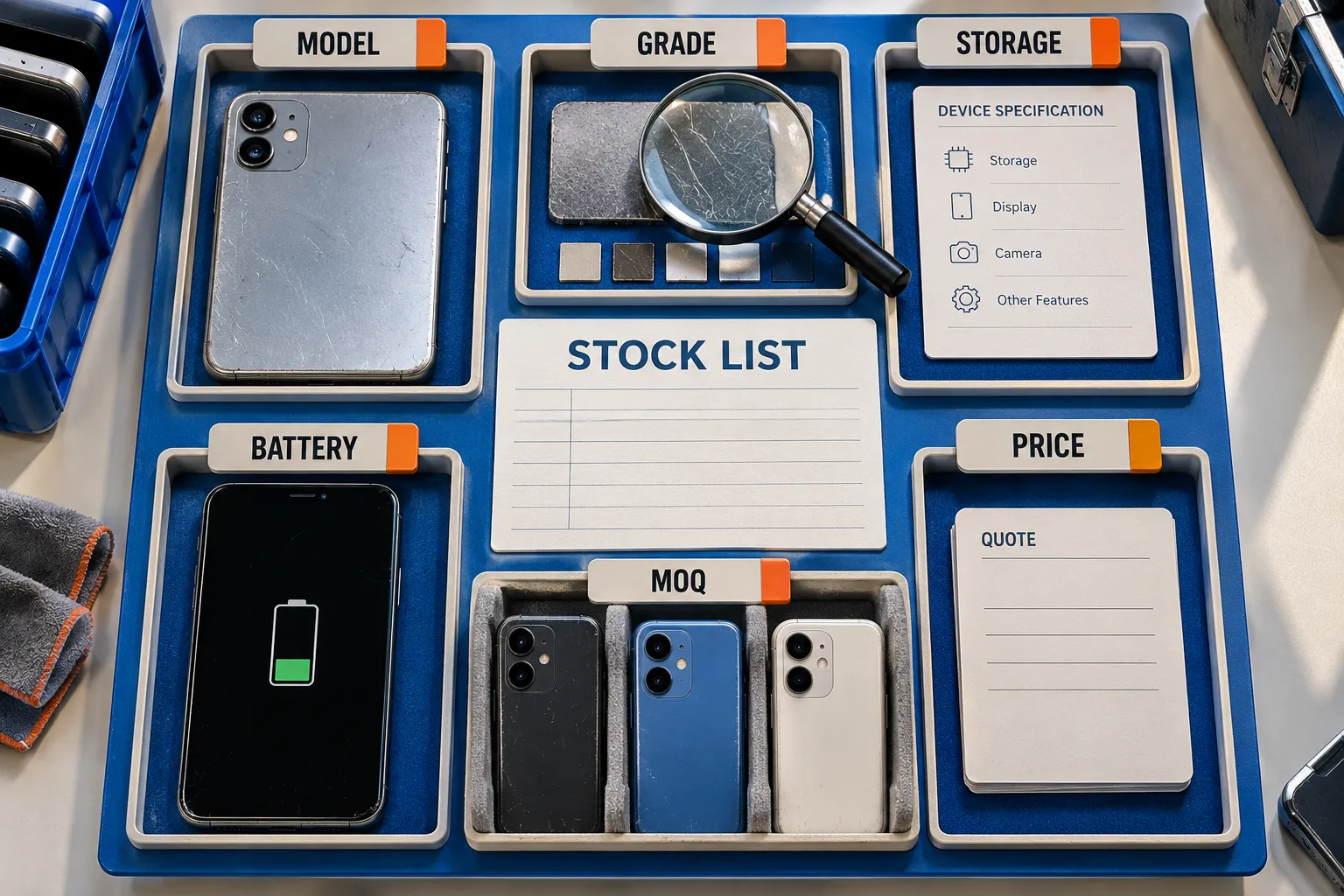
Most wholesale phone stock list formats share the same core columns, although labels vary by supplier. Reading them in a fixed order, from model down to price, keeps your comparison consistent when several suppliers send files at once. The table below summarises what each column tells you and what to verify.
| Column | What it tells you | What to verify |
| Model | The exact device and generation | Full name, region version, and network lock status |
| Grade | Cosmetic and functional condition | Written grade definition and sample photos |
| Storage | Memory capacity, such as 128GB | Consistent capacity across every row and lot |
| Battery | Health percentage or replaced status | Test method and whether the battery is original |
| MOQ | Minimum order quantity per line | Whether models can be mixed within one order |
| Price | Unit price, usually per piece in USD | Trade term, validity period, and currency |
How Do You Read Model, Storage, and Grade Columns?
Model and storage must identify one exact unit
A row that reads only “iPhone 13” is incomplete. Buyers need the storage size, the colour where relevant, and whether the phones are unlocked or carrier-locked, because each detail changes resale value. A well-prepared used iPhone stock list separates 128GB from 256GB and names Pro and Pro Max variants clearly. If the model line is vague, ask the supplier to clarify it before you compare prices.
Grade letters only matter when the standard is written down
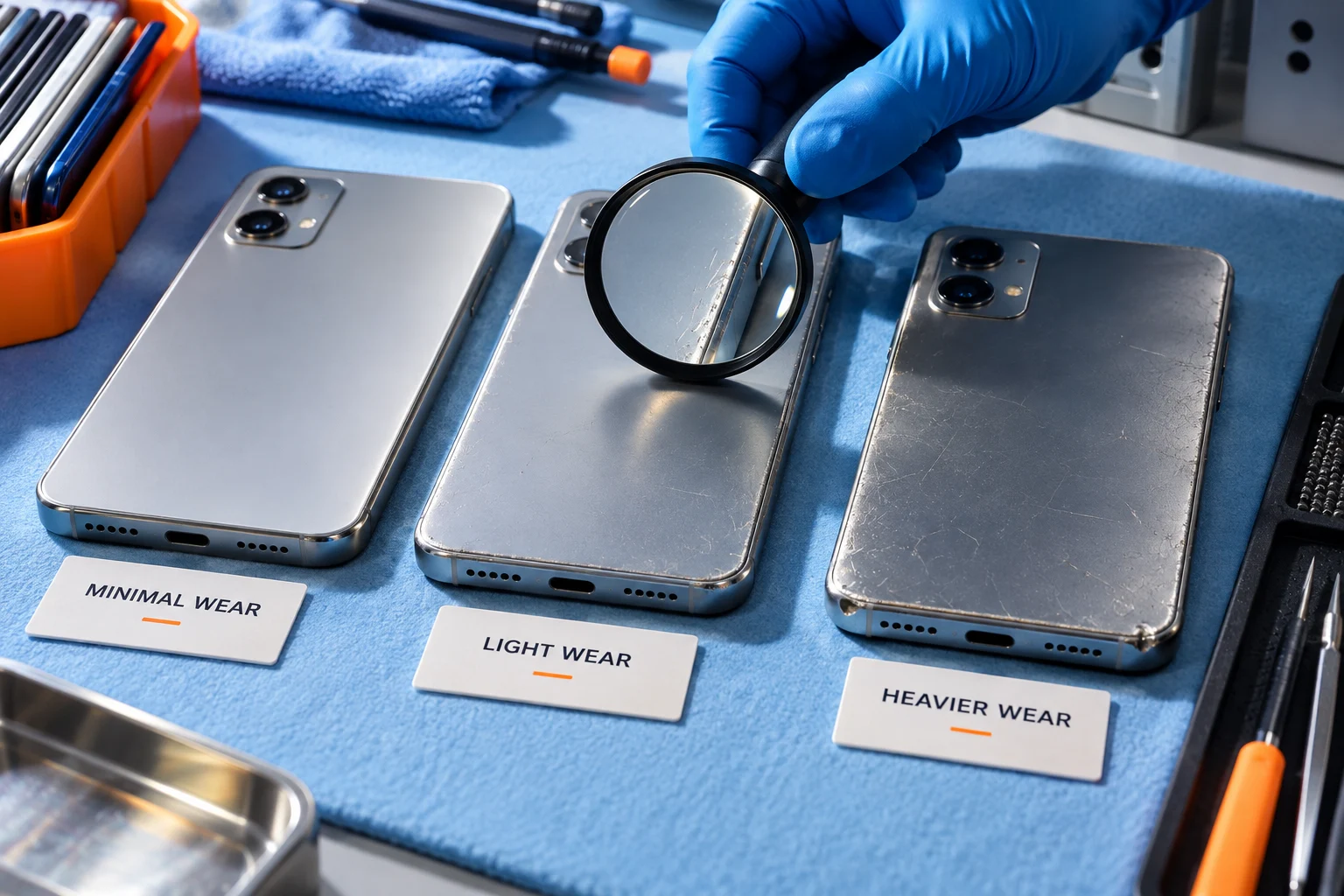
Grade A, B, and C are not universal terms, so one supplier’s Grade B may equal another supplier’s Grade A. Ask for the written grading standard, sample photos, and the functional tests applied to each grade. Our used phone grading guide explains the common differences in more detail, and the table below shows typical positioning.
| Grade | Typical cosmetic condition | Typical function | Best suited for |
| Grade A | Minimal wear, only faint marks | Fully tested, all functions working | Premium online resale |
| Grade B | Visible light scratches or scuffs | Fully tested, all functions working | Retail shops and mainstream resale |
| Grade C | Heavy wear, dents, or frame marks | Working, minor screen shadows possible | Budget markets and repair use |
What Do Battery Health and Testing Columns Reveal?
Battery percentage shows remaining capacity, not full history
Battery health is one of the strongest price drivers in any used iPhone stock list. A figure such as 88% describes maximum capacity, but it does not show whether the battery was replaced. Ask how the figure was measured and whether replaced batteries are marked separately. Our article on used iPhone battery health explains how buyers set minimum thresholds for each lot.
| Battery range | Typical positioning | Buyer action |
| 90% and above | Premium lots, strongest resale appeal | Confirm original battery; expect a higher price |
| 85% to 89% | Standard lots for retail and e-commerce | Common target for most wholesale buyers |
| 80% to 84% | Value lots for price-sensitive markets | Price should reflect a possible battery replacement |
| Below 80% | Repair or budget channels | Negotiate a discount or request a replacement |
IMEI and functional notes reduce import risk
Strong stock lists also record test results, such as Face ID, camera, speaker, and charging port checks, plus iCloud and blacklist status. These notes show whether phones can be activated and sold in your market. Before shipment, ask for an IMEI list that matches the confirmed order. Our IMEI verification guide and pre-shipment testing article cover what to request.

How Do MOQ, Price, and Availability Work Together?
MOQ and price tiers shape your true unit cost
MOQ, or minimum order quantity, is the smallest quantity a supplier will sell per model line or per order. A low price with a high MOQ can tie up cash, while a slightly higher price with a flexible MOQ may suit buyers testing a new market. Many suppliers also offer tiered pricing, where larger quantities reduce the unit cost. Always compare prices at your intended order size rather than the headline figure.
Availability and quotation validity protect your margin
Used phone prices move with supply and demand, so a listed price is usually valid for a short window only. Confirm the available quantity, price validity, trade term, and payment terms in a written quotation. Our article on why used phone wholesale prices change explains the drivers behind these swings. Fast confirmation matters, because popular models can sell out quickly.
| Term | What it means | Question to ask |
| MOQ | Minimum quantity per line or per order | Can I mix models and grades to reach the MOQ? |
| Price basis | EXW, FOB, or CIF pricing | Which costs does the price include? |
| Validity | How long the price stays fixed | How long will this quotation be held? |
| Available quantity | Units currently in stock | Are these units reserved once I confirm? |
Which Common Mistakes Should Buyers Avoid?
Comparing prices without comparing grades
The cheapest row on a refurbished phone stock list is rarely the best value. When two suppliers use different grade standards, the lower price often reflects heavier wear or weaker testing. Compare cosmetic definitions, function tests, and battery data first, and only then compare the price per unit. This keeps the comparison fair and prevents costly surprises on arrival.
Ignoring battery replacement and repair notes
A high battery percentage can mislead when the battery was replaced with a non-original part. Buyers should also ask about screen or housing replacements, since these affect customer confidence and warranty claims. Request a clear repair status column, or a written statement of original versus replaced parts, for every lot.
Overlooking lock status and regional versions
Carrier-locked or region-specific phones can be unusable or harder to sell in your market. A list that omits lock status, iCloud status, or region code leaves a serious gap in your risk assessment. Confirm that the phones are unlocked and iCloud-free, and that the network bands suit your country, before payment.
Treating an old stock list as live inventory
Stock lists age quickly, and a file sent last week may show models that have sold or prices that have moved. Always ask for the latest version, confirm quantities in writing, and avoid paying a deposit until availability is verified. A short delay costs far less than a rejected order or a delayed shipment.
How Can You Compare Stock Lists Before Placing an Order?
Mini case study: two lists for the same iPhone 12 order
Consider an illustrative example. An overseas phone store owner receives two used iPhone stock list files that both include iPhone 12 128GB. List A shows a lower price but gives no grade definition or battery data. List B costs slightly more, but it states a written Grade A standard, 85%+ battery health, and unlocked status. The buyer requests samples from List B and places a trial order.
A simple checklist turns the list into a decision
Before placing an order, run each candidate row through a short checklist. Rows that pass every check are ready for a quotation, while rows with gaps should trigger written questions. Also confirm packaging, shipping method, and export documents before paying a deposit. The table below turns the earlier sections into a practical decision tool for procurement teams.
| Check | Pass signal | Red flag |
|---|---|---|
| Model and storage | Exact model, capacity, and lock status | Vague model names |
| Grade | Written standard with sample photos | Letter only, no definition |
| Battery | Percentage listed, replacements marked | Blank or “good” only |
| Testing | Function, IMEI, and iCloud results | No test data shared |
| MOQ and price | Tiers, trade term, and validity stated | Price with no terms |
| Packing and shipping | Packing and export documents described | No shipping details |

Request Stock List
Ready to See Current Stock? Send us your target models, grades, storage sizes, and quantities. We will reply with the latest stock list, including battery data, MOQ, and pricing.
Reading a used phone wholesale stock list well is a procurement skill that protects margins and reduces import risk. Check the model, grade definition, storage, battery data, MOQ, and price terms in a consistent order, and insist on written confirmation. When a supplier answers these points clearly, you can order with more confidence. To see current availability, request the latest stock list from INENG today.

Frequently Asked Questions
What is a used phone wholesale stock list?
It is a supplier’s current inventory sheet listing models, grades, storage, battery health, quantities, and prices for bulk buyers. Because it changes often, confirm availability before ordering.
How do I compare grades between different suppliers?
Ask each supplier for a written grading standard and sample photos of every grade. Compare cosmetic limits and functional tests, not just letters, before you compare prices.
Can I mix models to meet the MOQ?
Some suppliers allow mixed models in one order, while others apply the MOQ per model line. Ask before requesting a wholesale phone stock list quotation, since it changes your total investment.
How often is a refurbished phone stock list updated?
Active suppliers usually update daily or several times a week. Check the list date and confirm quantities in writing to avoid ordering models that have already sold.
How can I verify phones before shipment?
Request an IMEI list, a functional test report, and photos or video of the packed units. Compare them with your confirmed order before final payment.