
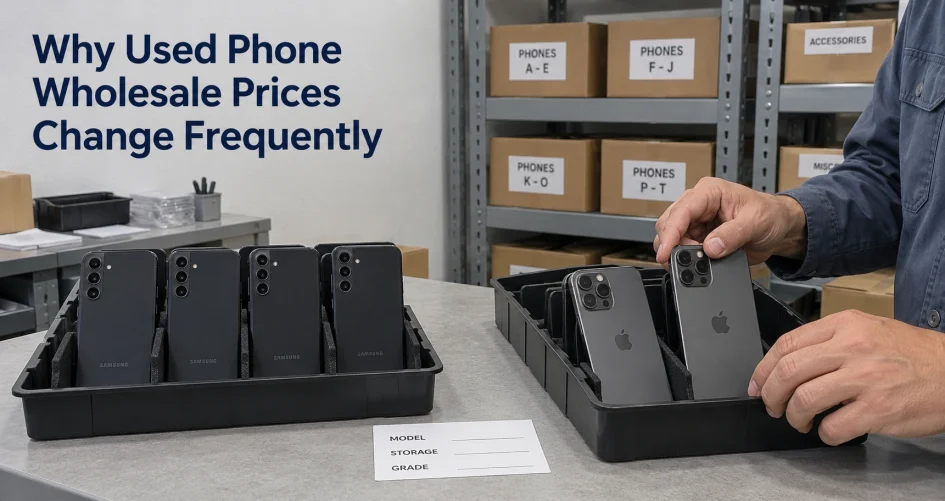
Many overseas buyers receive a quotation on Monday and find the same model priced differently by Friday. For wholesalers, importers, and phone store owners, this movement makes budgeting difficult and raises doubts about supplier fairness. In reality, used phone wholesale prices follow clear patterns tied to supply, demand, and device condition.
This guide explains why prices move by model, grade, battery health, storage, and stock availability. It also shows how to compare a used phone price list on equal terms, avoid costly pricing mistakes, and plan purchases with INENG TECHNOLOGY CO., LIMITED, a China-based supplier of used and refurbished phones.
Why Do Used Phone Wholesale Prices Change So Often?
Used phones are traded like a commodity, not a fixed catalog item
New phones carry a manufacturer-set price, but used phones are priced by what the market will pay today. Each batch has its own mix of models, grades, and battery conditions, so no two lots are identical. Suppliers update quotations whenever purchasing costs shift, which is why a used phone price list should be read as a snapshot of current conditions, not a permanent rate.
The used phones market price reflects supply, demand, and currency
The used phones market price rises when demand outpaces available stock and softens when large volumes arrive at once. Trade-in programs, new model launches, and regional demand all shape this balance. Exchange rates and freight costs add another layer, because buyers in different countries judge wholesale used phone prices by their landed cost in local currency, not by the ex-works figure alone.
| Factor | What Changes | Price Sensitivity | Buyer Action |
| Model and release cycle | Newer launches shift demand | High | Track core models |
| Storage capacity | Higher capacity earns a premium | Medium | Confirm GB per line |
| Grade | Cosmetic and functional condition | High | Get written grade definitions |
| Battery health | Capacity affects returns | Medium to high | Request battery data |
| Supply and stock | Trade-in volume and inventory | High | Ask about stock |
| Currency and freight | Landed cost shifts | Medium | Compare under one Incoterm |
Launch cycles and seasonal demand create predictable price swings
New flagship launches push earlier models into the used market as owners upgrade, which increases supply and softens prices for those models. Festive seasons, back-to-school periods, and regional shopping peaks lift demand for affordable devices. Experienced buyers track these cycles and order before demand peaks, when stock availability is better and quotations are less aggressive.
| Market Signal | Likely Price Effect | Practical Response |
| New flagship launch | Older models gain supply and prices ease | Buy previous-generation models |
| Festive or shopping season | Demand rises and stock tightens | Order early and confirm availability |
| Large trade-in or lease returns | Supply spikes for specific models | Ask which models are new in stock |
| Currency or freight change | Landed cost shifts | Compare quotes on the same terms |
How Do Model, Storage, Grade, and Battery Health Set the Price?
Model and storage capacity set the baseline price
Model demand sets the starting point for used phone wholesale prices. Popular iPhone and Samsung models with strong resale demand hold value longer than niche or older devices. Within a single model, storage creates separate price steps, since 128GB, 256GB, and 512GB units attract different buyers. Always confirm the exact model number and storage capacity on each line of the quotation to avoid mismatched expectations.
Grade decides where wholesale used phone prices land
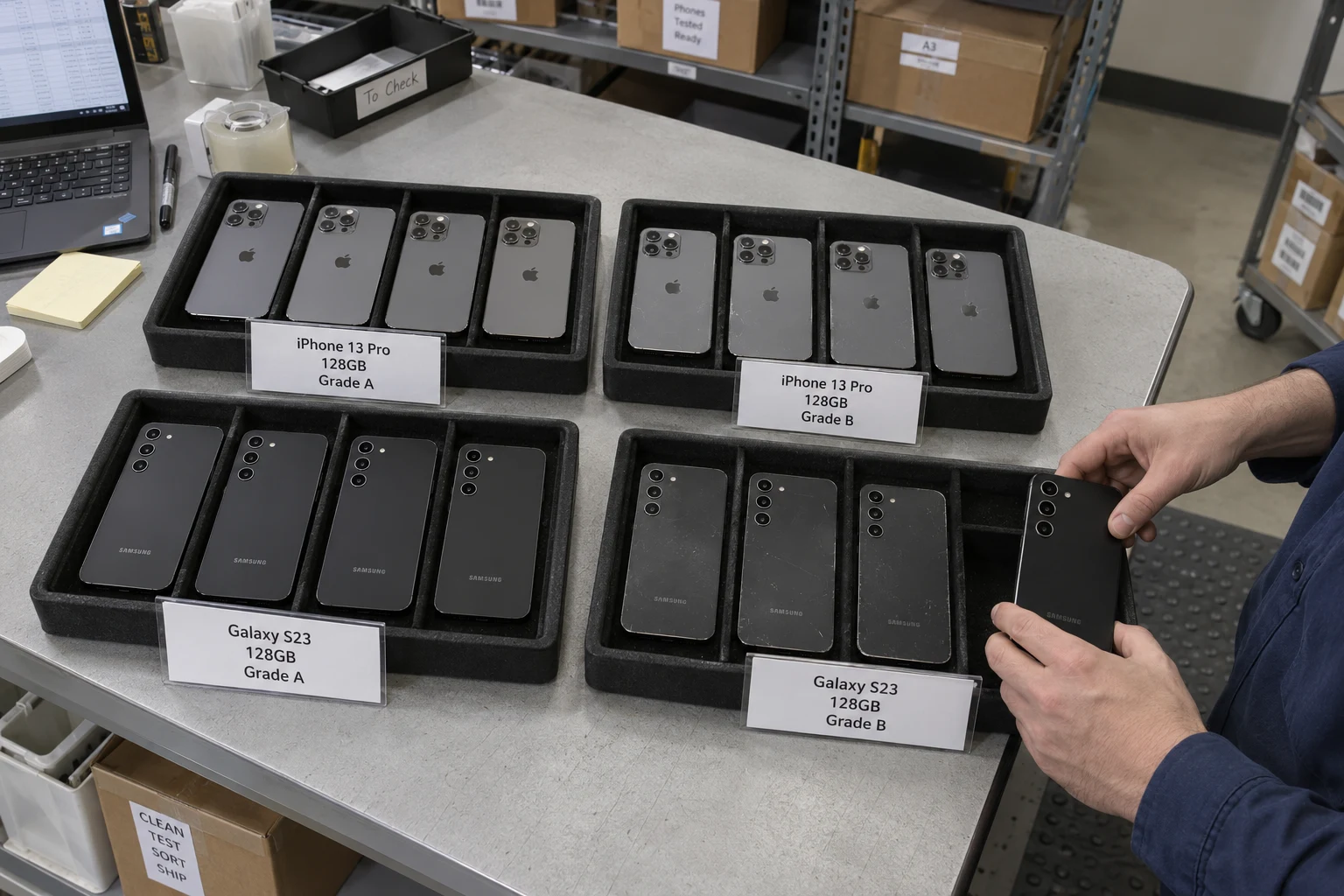
Grade often explains the biggest gap between two quotations. One supplier’s Grade A may allow light marks that another treats as Grade B, so the label alone tells you very little. Ask for written used phone grading standards, sample photos, and functional test criteria before comparing offers. Consistent grading protects your resale margin and reduces disputes after delivery.
| Grade | Cosmetic Condition | Function | Best-Fit Buyer | Price Position |
| Grade A | Minimal or no visible wear | Fully working and tested | Retail stores, e-commerce sellers | Highest |
| Grade B | Light scratches or minor marks | Fully working and tested | Resellers, mixed-market distributors | Mid-range |
| Grade C | Visible scuffs or dents | Working, minor issues possible | Repair shops, budget markets | Lower |
Battery health changes both resale value and return risk
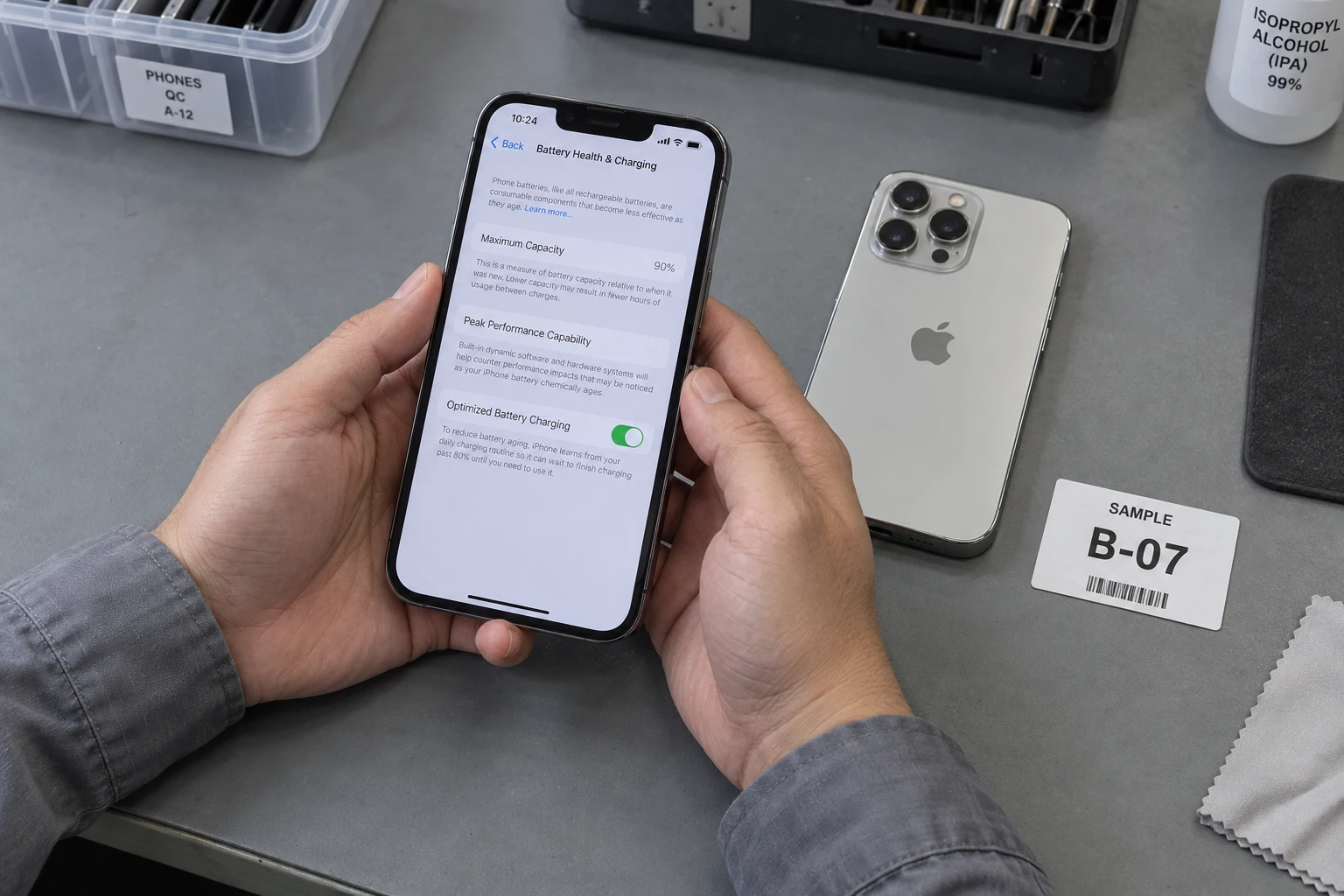
Battery condition shapes how a used phone performs in daily use, so it strongly influences resale value. High battery health supports a premium price, while lower capacity usually means a discount or a replacement cost. Request battery health screenshots or test reports for sample units, especially for iPhone lots where readings are easy to verify. Our guide to used iPhone battery health explains the testing steps in detail.
| Battery Health | Common Trade Treatment | What It Means for You |
| 90% and above | Premium unit within its grade | Best for retail-ready stock and stronger margins |
| 85% to 89% | Standard unit | Suits most resale channels |
| 80% to 84% | Discounted or clearly labeled | Fits budget buyers, so check replacement cost |
| Below 80% | Priced down, replacement expected | Better for repair shops or after battery replacement |
How Can Buyers Compare a Used Phone Price List Fairly?
Compare quotations on identical specifications and terms
A lower price only helps when the specification matches. Compare grade definitions, battery thresholds, storage, lock status, accessories, and packaging line by line. Confirm MOQ, Incoterms, payment terms, and quotation validity as well, because each of these changes the final landed cost. A reliable supplier answers these points in writing before you send a deposit.
| Check | Item to Confirm | Why It Affects Price | Question to Ask the Supplier |
|---|---|---|---|
| ☐ | Grade standard | One label can hide different conditions | Can you share grade definitions and photos? |
| ☐ | Battery health | Lower capacity reduces value | What is the minimum battery level per grade? |
| ☐ | IMEI and lock status | Blacklisted or locked units lose value | Do you provide IMEI records and lock status? |
| ☐ | Functional testing | Untested faults create returns | Which functions are tested before shipment? |
| ☐ | MOQ and stock | Volume changes the unit price | What are the MOQ and current stock? |
| ☐ | Packing and shipping | Affects landed cost and damage risk | How are units packed, and which Incoterm applies? |
| ☐ | Quotation validity | Prices move within days | How long is this price list valid? |
Evaluate suppliers on process, not only on price
Supplier evaluation matters as much as the quotation itself. Look for consistent grading, IMEI checks, pre-shipment testing, and clear export documentation. Order a sample batch first, then compare the received units with the listed grade and battery data. This step reduces import risk and shows whether a price list stays reliable across repeat orders. Our bulk used phone QC checklist covers the key inspection points.

Mini case study: two quotations, one clear winner
Illustrative scenario: a distributor compares two quotations for 200 used iPhones. The first is cheaper but lists only “Grade A,” with no battery data or IMEI records. The second costs slightly more and includes battery ranges and IMEI lists. Sample testing shows mixed battery levels in the cheaper batch, which forces extra sorting and discounts. The second batch sells faster, so the higher quotation delivers the better margin.
Which Mistakes Should Buyers Avoid When Reading Used Phone Wholesale Prices?
Comparing prices without comparing grade definitions
The most common error is choosing the lowest number on a used phone price list without checking what each grade means. Two suppliers can label very different conditions as Grade A, so a lower price may simply reflect lower quality. Ask for written definitions and photos, then compare units of equal condition before you decide.
Ignoring battery health and functional test results
Buyers sometimes focus on model and storage only, then discover weak batteries or faulty functions after arrival. Those units need repair, discounting, or returns, which erases the saving from a low quotation. Ask for battery health data and a list of tested functions, including cameras, speakers, charging ports, and biometric features, before you approve the order.
Skipping IMEI and lock-status verification
A phone with a blacklisted IMEI, an account lock, or a carrier lock can lose most of its resale value, and unusually cheap offers sometimes hide these problems. Request IMEI records, confirm each device is unlocked and clear, and run random checks on received units. Our guide to IMEI verification for used phones shows how to do this efficiently.
Treating an old price list as a current price
Used phone wholesale prices can move within days, so last month’s list is only a rough guide. Ordering on outdated numbers often leads to disputes or reduced stock. Always confirm the date and validity period of the quotation, and check availability at the same time, because popular models can sell out between quotation and payment.
How Can You Plan Purchases Around Price Changes?
Build a buying routine around used phone wholesale prices
Rather than reacting to every change, set a regular buying rhythm. Request an updated price list on a fixed schedule, track two or three core models, and keep a small budget buffer. Consolidate needs into larger orders that reach the MOQ, since volume often improves unit pricing and lowers freight cost per phone. Our guide to sourcing refurbished phones from China outlines the full process.
Prepare packaging and export details before payment
Confirm packaging, carton labeling, and export documents before payment so the agreed price holds through shipment. Ask how screens are protected, how IMEI lists match each carton, and which shipping method suits your order size. Early preparation prevents delays and last-minute cost changes, and it keeps the delivered goods aligned with the original quotation.

Get Latest Price List
Ready to Compare Current Used Phone Prices? Send us your target models, grades, storage, and quantity. Our team will reply with current used phone wholesale prices and stock availability.
Used phone wholesale prices change because model demand, grade, battery health, storage, and supply all change. Once you understand these drivers, a shifting price list becomes a planning tool rather than a source of doubt. Compare quotations on identical terms, verify IMEI and battery data, and buy on a routine. INENG TECHNOLOGY CO., LIMITED can share current models, grades, and stock availability for your market.
Frequently Asked Questions
How often do used phone wholesale prices change?
Prices can shift weekly, and for popular models sometimes within days, depending on stock levels and demand. For this reason, most suppliers issue a used phone price list with a limited validity period. Confirm the quotation date and request an update before every order to avoid working with outdated numbers.
Why does the same model have different wholesale prices?
Grade, storage, battery health, lock status, and available stock all differ between lots, even for one model. A supplier’s grading standard also affects the price. Compare wholesale used phone prices only after matching these details, otherwise the cheapest offer may simply describe a lower-quality batch.
Does battery health really change used phone wholesale prices?
Yes. Battery capacity affects daily performance and return rates, so suppliers price higher-health units at a premium. Lower readings often reduce the price or require a replacement. Ask for battery data on sample units and agree on a minimum threshold per grade in writing.
Is Grade A the same at every supplier?
No. Grading is not fully standardized across the trade, so one supplier’s Grade A may resemble another’s Grade B. Request written standards, sample photos, and functional test criteria. Approving a small sample order first is the safest way to confirm the real condition of the units.
How can I check the used phones market price before ordering?
Collect quotations from several suppliers for identical model, storage, grade, and battery specifications. Track demand for two or three core models and note launch and seasonal cycles. Ask each supplier for the latest price list and stock availability so you can judge the used phones market price with confidence.
Can I lock in used phone wholesale prices for a larger order?
Many suppliers confirm the price once the order and deposit are agreed, subject to stock and stated terms. Ask for the validity period, MOQ, and payment conditions in writing. For repeat volumes, discuss a planned schedule so both sides can manage price changes more predictably.