

Shipping used phones across borders is where many wholesale orders succeed or fail. Even excellent stock can arrive with crushed cartons, customs delays or missing paperwork when logistics are left to the last minute. This guide explains used phones international shipping from the buyer’s side: how to choose a freight method, what bulk used phones export packing should include, which documents to request, and what to confirm with your supplier before dispatch. Use it to protect your margin and reduce import risk.
How Does Used Phones International Shipping Work from China?
Every Shipment Follows Six Stages from Order to Delivery
Most cross-border orders follow the same sequence, whether you buy one hundred units or several thousand. The supplier confirms stock, grades and pricing, tests and packs the goods, and hands them to a forwarder. Customs clearance then takes place in both countries before delivery. Newcomers can read how to import used phones from China for the full buying process behind these stages.
| Stage | What Happens | Buyer Action |
| Quotation and order | Stock, grades, MOQ and price confirmed | Approve the written quotation |
| Testing and packing | Devices tested, graded and cartoned | Request test records and packing photos |
| Export clearance | Supplier files export declaration | Confirm documents and shipping terms |
| Main transport | Air, express or sea freight departs | Track shipment and share the ETA |
| Import clearance | Customs reviews goods; duties are paid | Prepare importer details and permits |
| Delivery and inspection | Cartons reach your warehouse | Count, photograph and inspect cartons |
Air, Express and Sea Freight Suit Different Order Sizes
The right method depends on order value, urgency and destination. Express couriers suit samples and trial orders, air freight balances speed and cost for mid-size wholesale lots, and sea freight is reserved for very large volumes where transit time matters less. Because phones are compact, high-value goods, most refurbished phones export orders travel by air or express for better security.
| Method | Best For | Indicative Transit | Key Consideration |
| Express courier | Samples, trial orders and small lots | 3–7 days | Higher cost per unit; door-to-door tracking |
| Air freight | Mid-size wholesale orders | 5–10 days | Carrier battery rules apply; airport collection |
| Sea freight | Very large, non-urgent volumes | 3–6 weeks | Longest transit; needs moisture protection |

What Should Bulk Used Phones Export Packing Include?
Each Device Needs Individual Protection
Transit damage is one of the most avoidable losses in used phone shipping. Each handset should be wrapped or bagged separately, with the screen protected. Soft inner packaging prevents scratches between units. Phones should never sit loose in a carton, because vibration and stacking pressure can crack screens and stress batteries on long journeys.
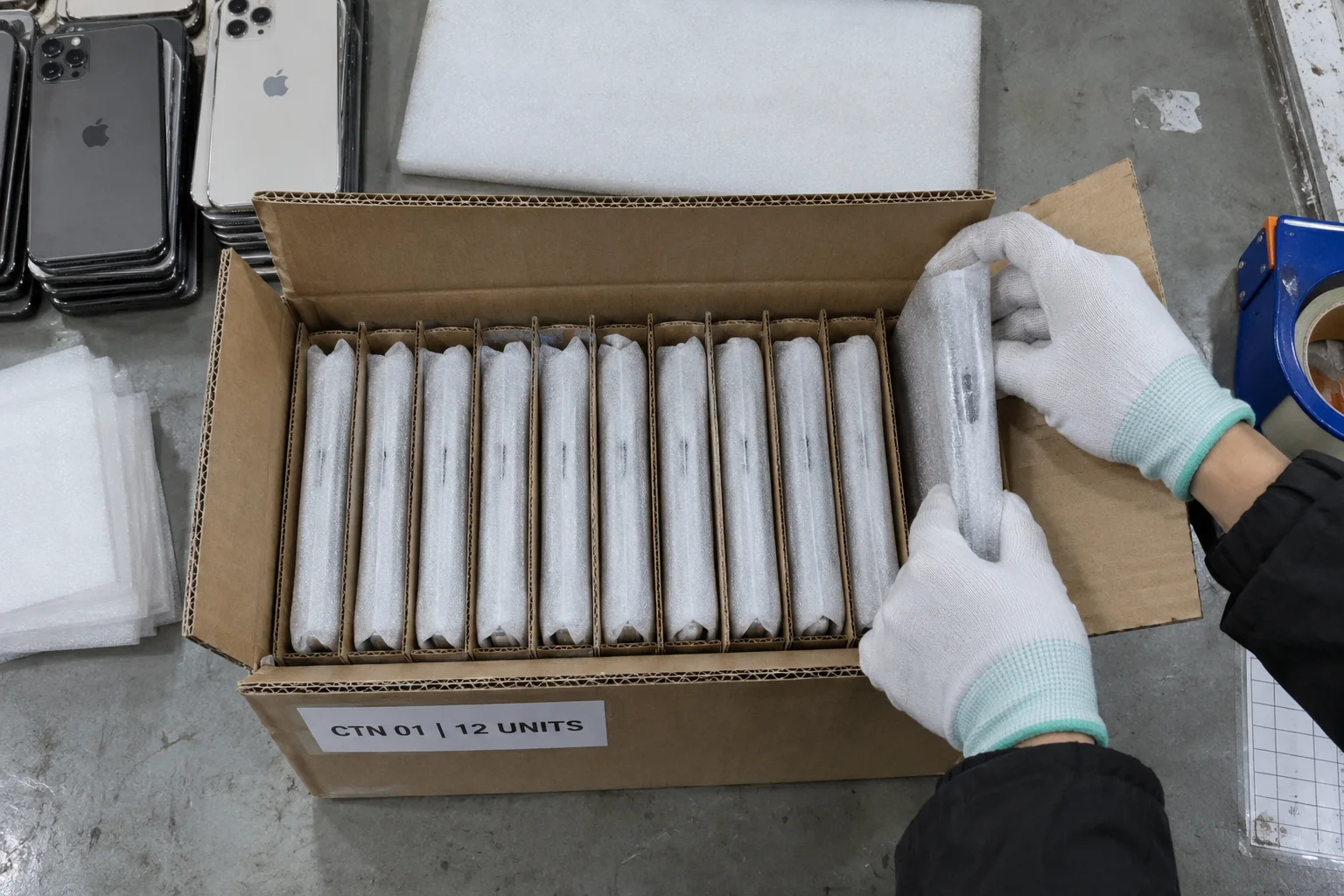
Cartons, Labels and Pallets Keep Large Orders Organized
For bulk used phones export packing, use strong double-wall cartons with a fixed quantity per box and no empty space. Label every carton with model, grade, quantity and a carton number that matches the packing list, so your team can inspect stock quickly on arrival. Larger shipments should be palletized and stretch-wrapped.
| Checkpoint | What to Verify | Buyer Check |
| Device protection | Each phone bagged or wrapped, screen protected | ✓ |
| Carton strength | Double-wall cartons, sealed, no empty space | ✓ |
| Carton labels | Model, grade, quantity and carton number shown | ✓ |
| Packing list match | Carton numbers and totals match the list | ✓ |
| Pallet and wrap | Stable, stretch-wrapped, moisture protected | ✓ |
| Packing photos | Photos or video of sealed cartons shared | ✓ |
Which Documents Are Needed for Refurbished Phones Export?
Core Commercial Documents Should Be Ready Before Dispatch
Accurate paperwork is the foundation of smooth customs clearance. The commercial invoice, packing list and shipping instructions must match exactly on model names, quantities, unit values and carton counts. Any mismatch can trigger inspection, storage fees or delays. Ask your supplier to share draft documents for approval before shipment, while the goods are still in the warehouse.
| Document | Purpose | Prepared By |
| Commercial invoice | Declares value and goods to customs | Supplier |
| Packing list | Lists cartons, models, grades, quantities | Supplier |
| Air waybill or bill of lading | Transport contract and shipment proof | Forwarder or carrier |
| Export declaration | Confirms legal export from China | Supplier or agent |
| Test and IMEI report | Records test results and device identity | Supplier |
| Import permit or certificate | Meets destination-country rules | Buyer or customs broker |
Import Rules Depend on Your Destination Market
Rules for importing used and refurbished electronics vary widely. Some countries require import licences, conformity certificates or pre-shipment inspection, while others restrict used equipment or apply special duty rates. Confirm the customs classification, commonly heading 8517.13 for smartphones, with a local customs broker, and check whether your market allows used phones before you place the order.
Lithium Battery Rules Affect Every Carrier
Phones contain lithium batteries, which carriers treat as regulated goods. Air and express shipments must follow carrier rules on packaging, labeling and documentation, and damaged or swollen batteries are typically refused. Ask your supplier and forwarder to confirm in writing that the shipment meets these requirements.
What Should Buyers Confirm With the Supplier Before Shipment?
Put Specifications, Grades and Quantities in Writing
Clear communication prevents most shipping disputes. Before paying, confirm models, storage, colors, grading standards, MOQ, unit price and stock in a written quotation. Agree how grades will be verified and ask for photos of sample units. Because stock moves quickly, ask how long the quotation stays valid and whether inventory can be reserved after your deposit.
Request Testing, IMEI and Battery Health Records
Before dispatch, ask for functional test results, IMEI records and battery health data for the shipped lot. This evidence confirms that stock matches the agreed grade and helps resolve any claim quickly. Matching IMEI lists to carton numbers also speeds up arrival checks.

Choose Shipping Terms That Match Your Experience
Shipping terms decide who pays for freight, who carries risk and who handles customs. New importers often prefer terms where the supplier manages more of the journey, while experienced buyers may use their own forwarder to control costs. Write the chosen term, delivery timeline and payment terms into the quotation to avoid surprises.
| Term | Supplier Handles | Buyer Handles | Best For |
| FOB / FCA | Packing, export clearance, carrier handover | Freight, insurance, import clearance | Buyers with their own forwarder |
| CIF / CIP | Freight and insurance to destination | Import clearance, duties, delivery | Buyers wanting simpler freight |
| DAP | Freight to named destination | Import clearance, duties, taxes | Newer importers |
Illustrative Scenario: A Shipment Planned Before Payment
Consider a phone store owner ordering a mixed lot of used iPhone and Samsung devices for resale. Before paying the deposit, the buyer requests a written quotation, draft invoice, test report and packing photos. The supplier confirms battery records and carton labels. The cartons arrive with matching counts and no customs queries because everyone worked from one approved set of documents.
What Common Mistakes Cause Used Phone Shipping Problems?
Approving Freight Before Confirming Documents
Some buyers book freight first and think about paperwork later. If the invoice, packing list and permits are not aligned, the shipment can stall at customs and generate storage charges. Confirm documents and import requirements before payment, and have a customs broker review drafts. Our guide to reducing risk when importing used phones covers this further.
Accepting Vague Packing Standards
A promise of “well packed” is not enough. Without agreed carton strength, individual protection and labeling rules, supplier and buyer will judge quality differently when damage occurs. Write packing requirements into the purchase agreement and ask for photos or video of sealed cartons. Clear evidence speeds up claims and keeps packing consistent from one shipment to the next.

Ignoring Lithium Battery and Carrier Rules
Treating phones as ordinary cargo can lead to refused bookings or held shipments. Carriers apply strict rules on batteries, and swollen or damaged units may not be accepted at all. Remove suspect devices during testing, keep battery health records and confirm the forwarder’s requirements early to avoid costly rebooking and delays.
Skipping Arrival Inspection and Record Keeping
Even well-run shipments need checking. Count cartons against the packing list, photograph any damage before opening, and compare IMEI numbers with the supplier’s records within the agreed claim period. Buyers who skip this step often cannot prove problems later. Keep documents, photos and messages together so any claim is supported by clear evidence.
Ask About Shipping
Planning an order of used or refurbished phones? Share your target models, grades, quantities and destination country with INENG TECHNOLOGY CO., LIMITED, and our team will help you confirm packing, documents and shipping options before you pay.
Successful used phones international shipping depends on preparation, not luck. Choose a freight method that fits your order, insist on clear packing standards, verify documents and confirm testing records before dispatch. These steps protect your stock, your cash flow and your customers. INENG TECHNOLOGY CO., LIMITED supplies used and refurbished smartphones to international buyers.
Frequently Asked Questions
What is the safest way to ship used phones internationally?
Air freight or express courier is usually safest for high-value phones because transit is shorter and tracking is reliable. For used phones international shipping, combine it with individual device protection, sealed double-wall cartons, cargo insurance, and a forwarder experienced in battery shipments. Very large, non-urgent orders can go by sea if cartons are moisture protected.
How are used phones packed for export?
Each phone is bagged or wrapped, then placed in strong double-wall cartons with no empty space and labeled by model, grade, and quantity. For bulk used phones export packing, larger orders are palletized and stretch-wrapped. Buyers should ask for photos or video of sealed cartons and check that carton numbers match the list.
Which documents do I need to import refurbished phones?
Buyers usually need a commercial invoice, packing list, air waybill or bill of lading, and export declaration, plus any import permit or certificate their country requires. Test and IMEI reports help resolve disputes. For refurbished phones export, missing paperwork is a common cause of delays, and requirements differ by market, so confirm them with a local customs broker.
Who pays customs duties on imported used phones?
It depends on the agreed shipping term. Under common terms such as FOB, CIF, and DAP, the buyer normally pays import duties and taxes at the destination. Only DDP shifts these costs to the seller. For used phone shipping, confirm the term, delivery point, and cost split in writing before paying a deposit, so there are no surprise costs when the shipment arrives.
What should I do if cartons arrive damaged?
Photograph the damage before opening the carton, record carton numbers, and notify the supplier and forwarder within the agreed claim period. Compare the contents with the packing list and IMEI records, and keep all documents, photos, and messages together as evidence for your claim. Prompt, well-documented claims are especially important in used phones international shipping.