When you are sourcing used phones in bulk from an overseas supplier, the single biggest hidden risk is not cosmetic condition, it is the status of the device itself. A phone can look flawless and still be reported lost, financed, or carrier-locked in a way that makes it impossible to activate for your customer. Without a reliable IMEI check, used phones with these hidden problems can slip into a shipment and only surface after the container has cleared customs and reached your warehouse.
This article explains exactly why IMEI verification matters, what a used phone blacklist check actually confirms, and how to build IMEI checks into your supplier evaluation process so that every unit you receive is genuinely unlocked and sellable.
What an IMEI Check Actually Confirms
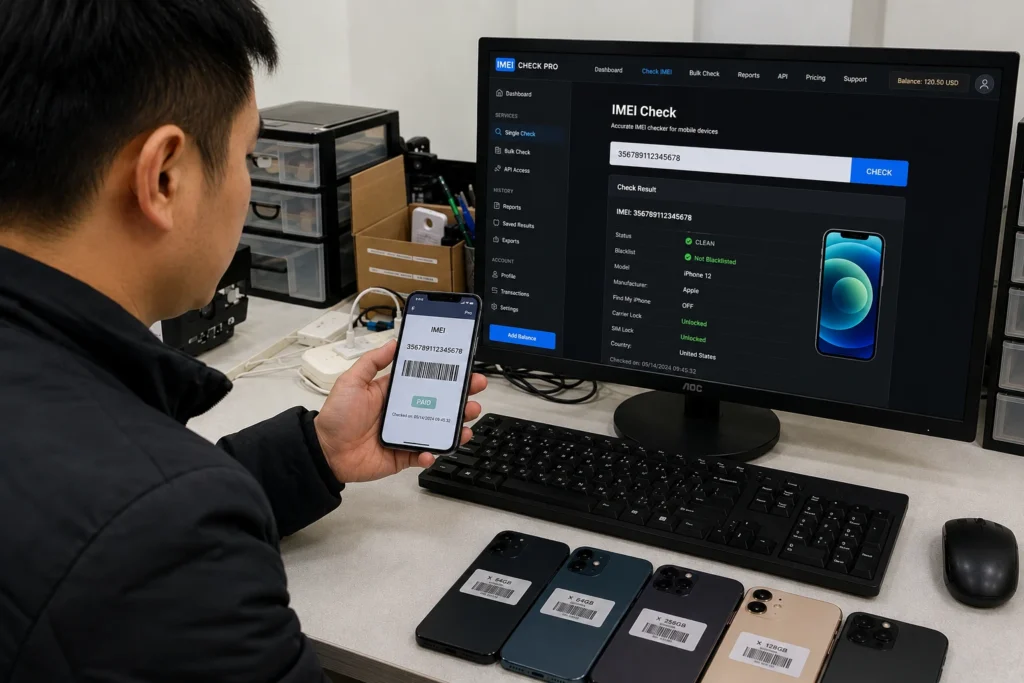
Every mobile phone carries a unique International Mobile Equipment Identity number, commonly known as an IMEI, which functions much like a fingerprint for that specific device. An IMEI check queries this number against carrier and industry databases, most notably the GSMA blacklist, to confirm whether the phone has been reported lost, stolen, or is still tied to an outstanding finance agreement with its original carrier or retailer. For a wholesale buyer, this single lookup is often the most reliable way to confirm used phone IMEI status before money changes hands, because it tells you whether the device will actually activate normally once it reaches your customer’s hands, rather than relying on the seller’s word alone.
It is worth understanding that a device can pass every cosmetic and functional test, powering on, taking photos, making calls during a demonstration, and still fail an IMEI check once it reaches the destination network. This happens because blacklisting is often applied after a device has already left its country of origin, or because a carrier lock only becomes apparent once a different SIM card is inserted in a different region. This is precisely why IMEI check used phones procedures need to be run as a standard, non-negotiable step in your sourcing process rather than treated as an optional extra reserved for higher-value orders.
Why IMEI Verification Reduces Import Risk for Wholesale Buyers
Import risk in the used and refurbished phone trade rarely comes from a single catastrophic failure; it usually accumulates from a small percentage of problematic units scattered across an otherwise good shipment. A batch of five hundred phones with even a two percent blacklist rate means ten devices that cannot be activated normally, and each of those represents a refund, a customer complaint, or a costly reshipment once the problem is discovered locally. Building a documented IMEI check into your procurement process converts this unpredictable risk into a known, manageable cost that is resolved before the goods ever leave the supplier’s warehouse, rather than after they have already reached your own customers.
There is also a reputational dimension that many first-time importers underestimate until it affects them directly. A repair shop owner or e-commerce seller who unknowingly resells a blacklisted or financed device is the one who receives the customer complaint, not the original overseas supplier, and disputes over locked phones tend to spread quickly through online reviews and local buyer communities. A supplier who performs and documents a used phone blacklist check as standard practice is effectively protecting your storefront reputation as much as their own, which is why this single verification step deserves more attention in supplier evaluation than it typically receives.
How We Perform IMEI Checks Before Shipment
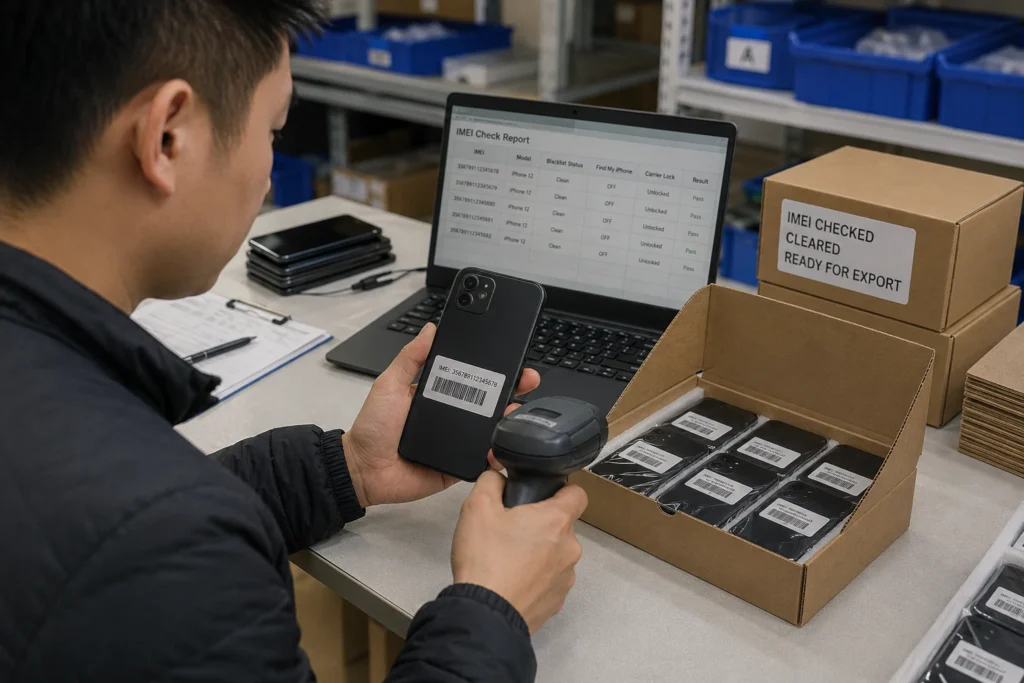
At INENG TECHNOLOGY CO., LIMITED, IMEI verification is built into our intake and quality control workflow rather than treated as a final, optional check before packing. The table below summarizes the specific checks we run on every unit, the database or method used, and why each check matters to a wholesale buyer evaluating stock for import.
| Check Performed | Method Used | Why It Matters to Buyers |
| GSMA blacklist status | IMEI lookup against the global GSMA blacklist database | Confirms the device has not been reported lost or stolen by a previous owner |
| Carrier lock status | Network status query against major carrier databases | Confirms whether the unit is genuinely unlocked or restricted to one carrier |
| Financing or installment lock | Cross-check against carrier finance and installment records | Prevents activation failures caused by unpaid device financing plans |
| Activation Lock / Find My iPhone | Apple activation status check during software verification | Confirms the device is not still tied to a previous owner’s account |
| Duplicate or cloned IMEI check | Comparison against manifest and internal database records | Detects tampered or duplicated IMEIs before they reach graded stock |
Table 1: IMEI and lock-status checks applied to every unit before shipment.
This layered approach matters because a single blacklist lookup does not always capture every possible restriction on a device. A phone can be completely clean on the GSMA blacklist and still be carrier-locked, tied to an active installment plan, or logged into a previous owner’s account, any one of which will prevent your customer from activating it normally. Running all five checks together, rather than relying on just one, is what allows us to confidently describe stock as unlocked used phones ready for resale in your target market.
Documentation You Should Expect From a Supplier
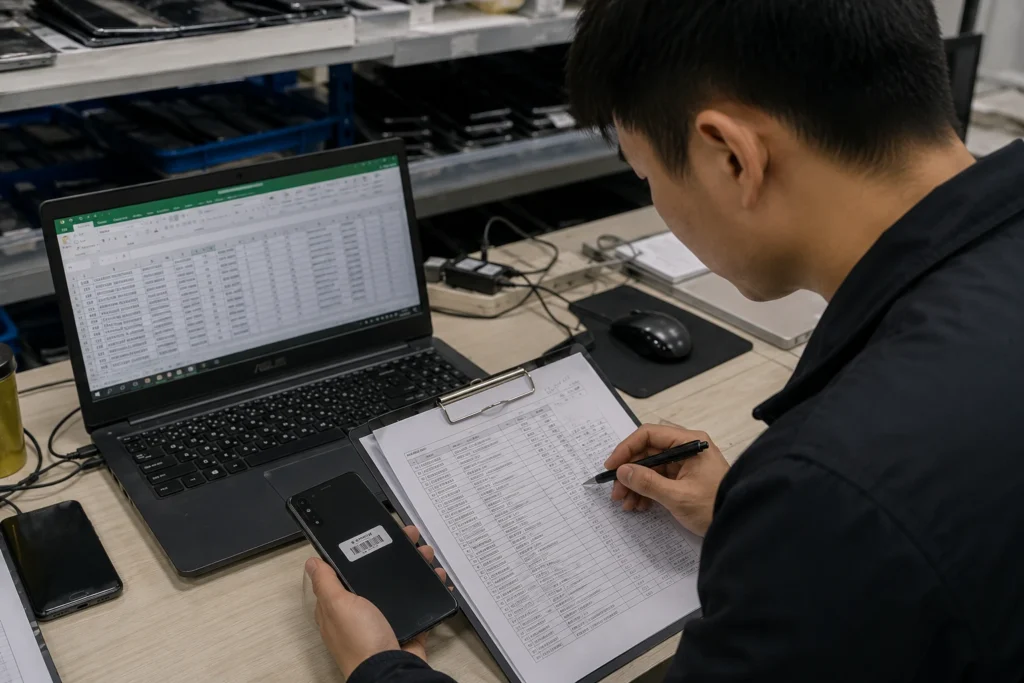
A supplier who takes IMEI verification seriously should be able to provide more than a verbal assurance that units are clean. At minimum, this means a sample IMEI list from the batch that you or a trusted partner can independently verify, a written statement of the checking method used, and a willingness to address any flagged units before final payment is made. Buyers who request this documentation as a standard part of quotation discussions tend to experience far fewer disputes after arrival than those who accept assurances without any supporting record.
IMEI Status Comparison: What Each Result Means for Your Order
Understanding the terminology used in IMEI reports helps buyers make faster, more confident decisions during supplier negotiations. The table below breaks down the common status results you may see on an IMEI report and explains what each one means for a wholesale order.
| IMEI Status Result | What It Means | Recommended Buyer Action |
| Clean / Clear | No blacklist report, no finance lock, carrier unlocked | Safe to include in graded stock without restriction |
| Blacklisted | Reported lost or stolen by a previous owner or carrier | Exclude from shipment; never accept as sellable stock |
| Carrier locked | Restricted to a specific network or region | Only accept if your market matches the lock, or request unlocking first |
| Financed / installment lock | Tied to an unpaid device financing agreement | Exclude from shipment until the lock is confirmed cleared |
| Activation Lock enabled | Still linked to a previous owner’s Apple ID or account | Do not accept; request removal or replacement before shipment |
Table 2: Common IMEI status results and recommended buyer actions.
Buyer Evaluation Table: IMEI Questions to Ask Any Supplier
When comparing suppliers, it helps to have a consistent set of questions ready rather than relying on general reassurances during a call. The table below sets out five practical questions worth asking about used phone IMEI status before you commit to an order, along with why each question matters and the answer a trustworthy supplier should be able to give.
| Question to Ask | Why It Matters | Answer to Expect |
| Do you check every unit, or only a sample? | Sample checks can miss a small percentage of blacklisted units in a batch | Every unit checked individually |
| Which databases or methods do you use? | Different databases cover different regions and carrier networks | GSMA blacklist plus carrier and finance checks |
| Can you share sample IMEI results before payment? | Independent verification builds trust ahead of a large order | Willing to share a sample list on request |
| What happens if a unit fails the check? | Clarifies whether flagged units are quietly shipped or properly removed | Excluded from shipment or replaced, never shipped silently |
| Are units confirmed unlocked for my specific market? | A clean IMEI does not always mean unlocked for every region | Carrier lock status confirmed per destination market |
Table 3: Supplier evaluation questions focused on IMEI verification and unlock status.
Common Mistakes Buyers Make With IMEI Verification
Across years of working with importers, distributors, and repair shop owners, we consistently see the same avoidable mistakes around IMEI verification, often on a buyer’s very first large order with a new supplier. The paragraphs below explain each mistake in enough detail that you can recognize the pattern in your own sourcing process before it becomes a costly lesson.
Accepting Verbal Assurance Instead of Independent Verification
Some buyers rely entirely on a supplier’s word that units are unlocked and blacklist-free without requesting proof of the IMEI check used phones process or independent confirmation. This is one of the most common and preventable mistakes in wholesale phone sourcing because verifying a handful of IMEIs from a batch usually takes less than a day and costs nothing. Yet it can prevent an entire shipment of otherwise functional phones from becoming unsellable in your destination market. Always ask for a sample IMEI list and verify the used phone IMEI status before paying the final balance, regardless of how long you have worked with a supplier.
Confusing a Clean Blacklist Result With Full Unlock Status
A common misunderstanding among buyers is assuming that a device passing a basic blacklist check is automatically ready for resale anywhere in the world. In reality, a phone can be completely clean on the GSMA blacklist while still being carrier-locked to a specific network, which will prevent it from activating normally on a different carrier in your destination market. It is important to confirm both blacklist status and carrier lock status separately, since unlocked used phones require clearance on both fronts, not just one.
Skipping IMEI Checks on Small or Repeat Orders
Buyers who have worked with a supplier successfully on previous orders sometimes skip IMEI verification on smaller or repeat shipments, assuming the same quality will continue automatically. Supply sources and batches change over time, even with a trusted supplier, and a consistent used phone blacklist check should be applied to every order regardless of size or history. Treating IMEI verification as a standard, non-negotiable step, rather than an occasional spot check, is what keeps quality consistent across dozens of orders rather than just the first few.
Not Clarifying What Happens When a Unit Fails the Check
Many buyers ask whether IMEI checks are performed but forget to ask the equally important follow-up question: what happens to a unit that fails? Some suppliers quietly ship flagged units anyway, hoping the issue goes unnoticed, while others properly exclude or replace them before the shipment leaves. Clarifying this process in writing before your order is confirmed removes any ambiguity and gives you a clear basis for a dispute if a flagged unit does slip through despite the stated process.
Overlooking Regional Carrier Lock Differences
A device that is fully unlocked and functional in one country can still be restricted in another due to regional carrier agreements that are not always visible in a basic IMEI report. Buyers importing into markets with strict network compatibility requirements should specifically request carrier lock confirmation for their destination region, rather than assuming a general unlock status applies universally. This extra clarification step is particularly important for buyers targeting multiple countries with a single shipment.
From Verification to Export: Where IMEI Checks Fit in Our Process
IMEI verification does not happen in isolation; it is one stage within a broader quality control workflow that also includes cosmetic grading, battery health verification, and full functional testing before any unit is approved for packing. Running the IMEI check early in this sequence, immediately after intake and before detailed functional testing, allows us to remove problematic units before investing further time in grading and testing devices that would never be sellable in the first place. This sequencing also means that by the time a unit reaches export packaging, its IMEI status has already been confirmed, checked a second time during final quality control, and recorded against the shipment manifest.
Once IMEI status is confirmed and testing is complete, units move into export preparation, which includes anti-static packaging, grade and IMEI labeling on each device, and carton-level packing lists matched to invoice data. Buyers who want more detail on this stage, including current minimum order quantities and pricing tiers, are welcome to review our wholesale price list and shipping and export guide before requesting a formal quotation.
Ask About IMEI Check Today
A reliable IMEI check used phones process is one of the simplest, most cost-effective ways to reduce import risk in wholesale phone sourcing, yet it remains one of the most overlooked steps by buyers focused primarily on price and cosmetic grade. At INENG TECHNOLOGY CO., LIMITED, every unit is checked against blacklist, carrier, and financing databases before it is packed for export, and we are always glad to share sample verification results or walk prospective buyers through the process before an order is confirmed. Reach out to Ask About IMEI Check now to receive current stock availability, verification details, and a quotation matched to your target markets.
Frequently Asked Questions
What is an IMEI check and why does it matter for wholesale buyers?
An IMEI check used phones process verifies a phone’s unique identity number against blacklist, carrier, and finance databases to confirm it has not been reported lost, stolen, or locked. This helps wholesale buyers avoid purchasing unsellable inventory and reduces business risk.
Do you check every unit, or only a sample from each batch?
Every unit in every shipment is individually inspected. We do not rely on sample-batch verification, and the used phone IMEI status of each device is checked regardless of order size.
Can you share IMEI check results before I pay the final balance?
Yes. We can provide a sample IMEI list from your order so you can independently verify the used phone IMEI status before making the final payment, giving you additional confidence before shipment.
What happens if a unit is found to be blacklisted or locked?
Any unit that fails our used phone blacklist check is immediately removed from graded inventory and is never shipped as sellable stock. The device is either replaced or excluded from the order.
Does a clean IMEI check guarantee the phone is fully unlocked?
Not on its own. A clean used phone blacklist check confirms the device has not been reported lost or stolen, but carrier lock status must also be verified to ensure it qualifies as one of our unlocked used phones for your destination market.
How long does IMEI verification take for a bulk order?
Our IMEI check used phones process is integrated into the standard intake and quality control workflow, so it does not add extra lead time. Verification results are available together with grading and functional testing reports.
Can I request carrier lock confirmation for my specific destination market?
Yes. We can verify carrier lock status for your target market to confirm the devices are compatible with local networks and qualify as unlocked used phones, which is especially important for international wholesale shipments.