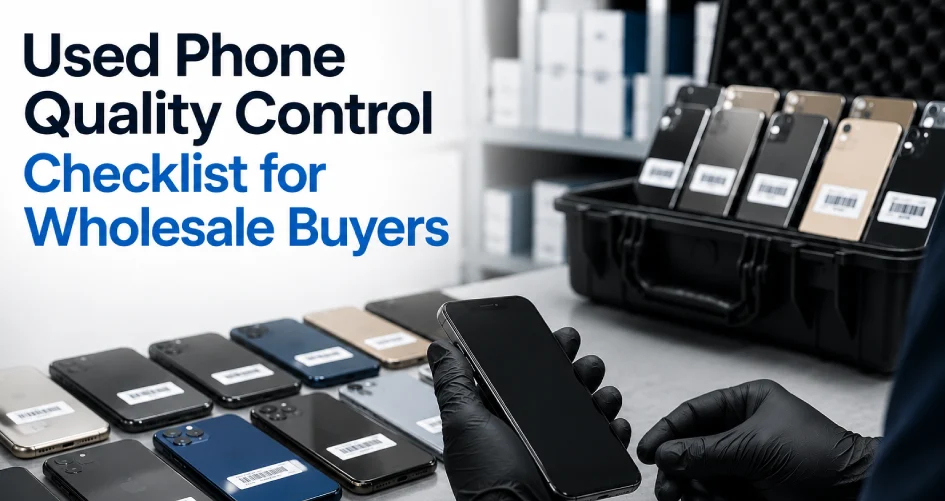
Not every supplier’s claim of “tested and graded” stock reflects the same underlying standard. Without a clear used phone quality control checklist, wholesale buyers have limited ability to compare suppliers meaningfully or to identify weak testing practices before an order ships. This guide sets out a practical used phone inspection checklist that can be applied to any supplier relationship, covering refurbished phone testing standards, battery health verification, IMEI checks, and functional testing, so that buyers can evaluate what genuine used phone QC looks like before committing to a purchase order.
Why a Used Phone Quality Control Checklist Matters Before You Order
Quality control standards vary considerably from one supplier to the next. Some operate a genuine multi-point diagnostic process on every unit, while others perform little more than a power-on test and describe the result as “tested.” For a wholesale buyer, this gap is rarely visible at the quotation stage; it only becomes apparent once stock has arrived, by which point returns, disputes, and dissatisfied end customers are already in motion. A structured checklist allows a supplier’s testing process to be assessed objectively before payment is made, rather than discovered after the fact.
The sections that follow set out what to review, in the sequence most experienced sourcing managers apply in practice: supplier evaluation, the distinction between grading and quality control, battery verification, IMEI and functional testing, and a framework for comparing quality control levels across competing suppliers.
Supplier Evaluation: Confirming Real Testing Standards Before You Buy
Before comparing unit prices across suppliers, it is worth first confirming that a supplier operates a documented quality control process rather than relying on verbal assurances alone.
Documented QC Procedures
A supplier that takes quality control seriously should be able to provide a written procedure describing each test performed and the pass-or-fail criteria applied to it. It is also worth establishing whether testing is carried out in-house or outsourced to a third party, since in-house quality control generally allows for faster feedback and more consistent standards across successive batches. For buyers sourcing multiple brands, it is reasonable to ask whether QC staff are trained specifically on Apple, Samsung, Huawei, and Xiaomi devices, since diagnostic procedures differ meaningfully depending on the device and operating system involved.
Sample Testing Reports
Before placing an order, request a sample QC report for a recently tested unit, ideally one matching a model under consideration. A useful report will include the IMEI, the battery health percentage, and an itemised list of the functional tests carried out, together with their results. For larger orders, it is also worth confirming whether QC reports can be issued per unit or per carton, which allows the buyer to cross-reference documentation against the physical shipment on arrival.
Grading Standards vs. Quality Control: Know the Difference
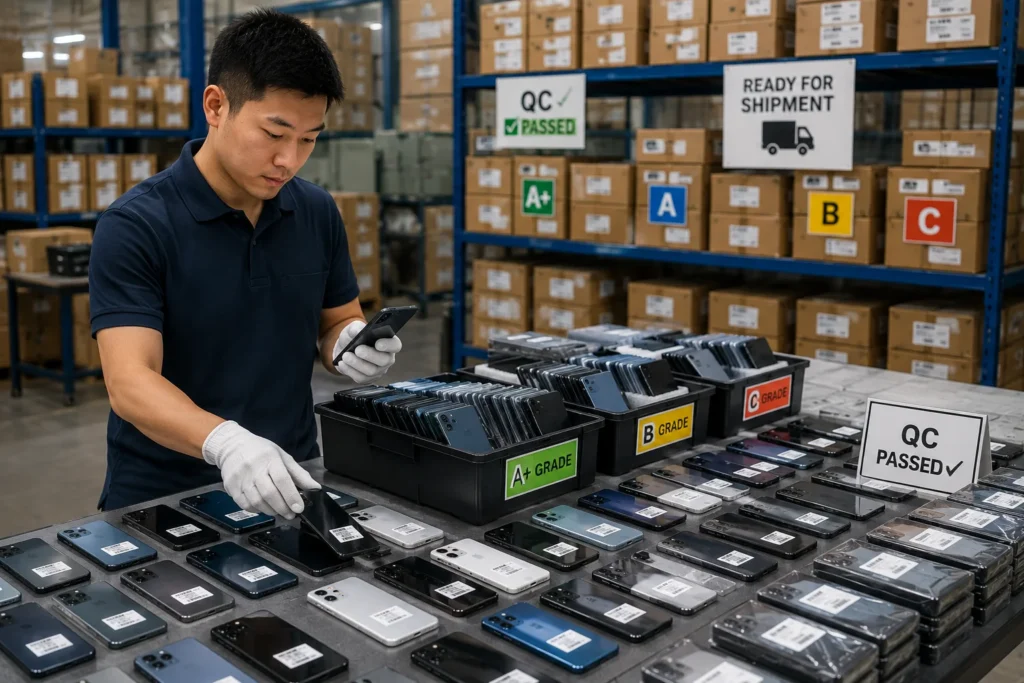
Buyers sometimes assume that grading and quality control describe the same thing, but in practice they answer different questions. Grading refers to the cosmetic condition of a device — the appearance of the screen and body — while quality control confirms that the device functions as expected. A phone can be cosmetically graded as Grade A and still fail a functional test if the underlying QC process is weak, which is why both should be documented separately within a supplier’s process rather than treated as interchangeable.
| QC Level | Testing Scope | Battery Check | IMEI Verification | Reporting | Best Suited For |
| Basic QC | Power-on and screen check only | Not measured | Not provided | None or verbal | Not recommended for bulk import |
| Standard QC | 10–15 point functional test | Basic health % check | Provided on request | Batch-level summary | Small to mid-size bulk orders |
| Advanced QC | 20+ point functional test, stress test | Diagnostic report per unit | Full list, blacklist-checked | Per-unit digital report | Large wholesale/import orders |
Battery Health Verification in the QC Process
Battery performance is among the most common sources of post-sale complaint, and it is also one of the most straightforward attributes to verify during quality control, provided the supplier tests for it properly rather than relying on estimation. Buyers should establish what minimum battery health percentage a supplier guarantees for each grade, with 80 percent or higher being the common benchmark for standard graded stock. It is equally important to confirm that battery health is measured using diagnostic software rather than visual inspection or a general estimate, and to request sample battery health screenshots or reports for units matching the target model and grade under consideration.
Where a battery has been replaced, the QC report should disclose whether the replacement part is original-grade or aftermarket, since this materially affects long-term performance and resale value.

IMEI Checks and Functional Testing Standards
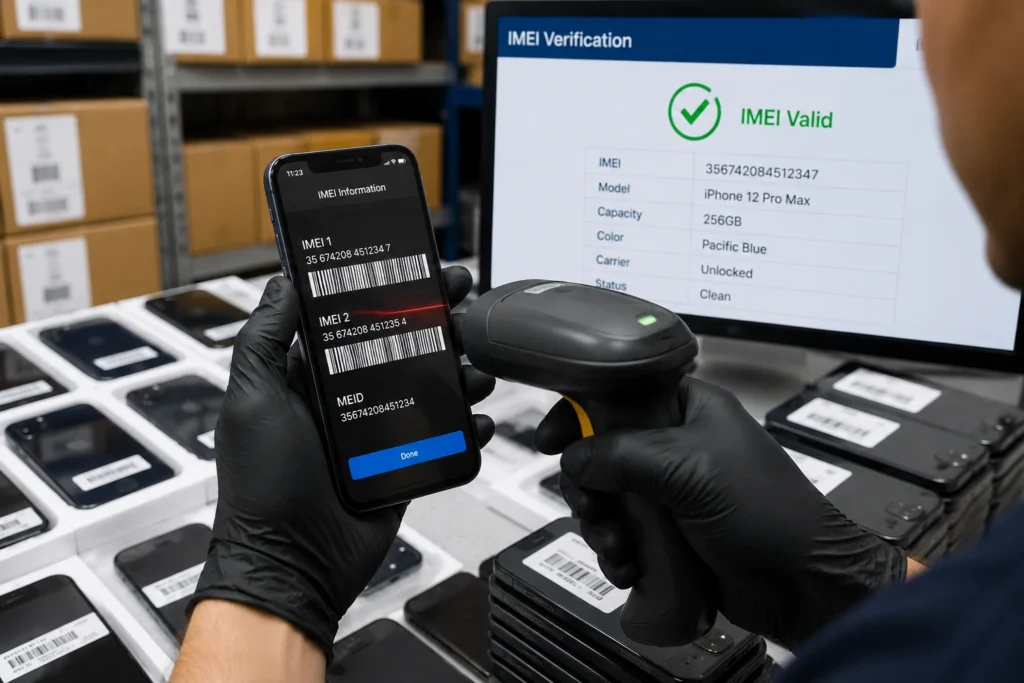
A complete used phone inspection checklist always includes IMEI verification alongside functional testing, since cosmetic grading and a working screen offer little assurance if a device is blacklisted or missing essential hardware function.
IMEI and Network Verification
Buyers should request the IMEI for each unit in an order and independently verify blacklist and carrier-lock status before releasing final payment. It is also worth confirming, in advance, the supplier’s policy for any unit that later fails IMEI verification — whether this results in replacement, refund, or a credit note — so that the terms are agreed before a dispute arises rather than negotiated after one.
Core Functional Test Points
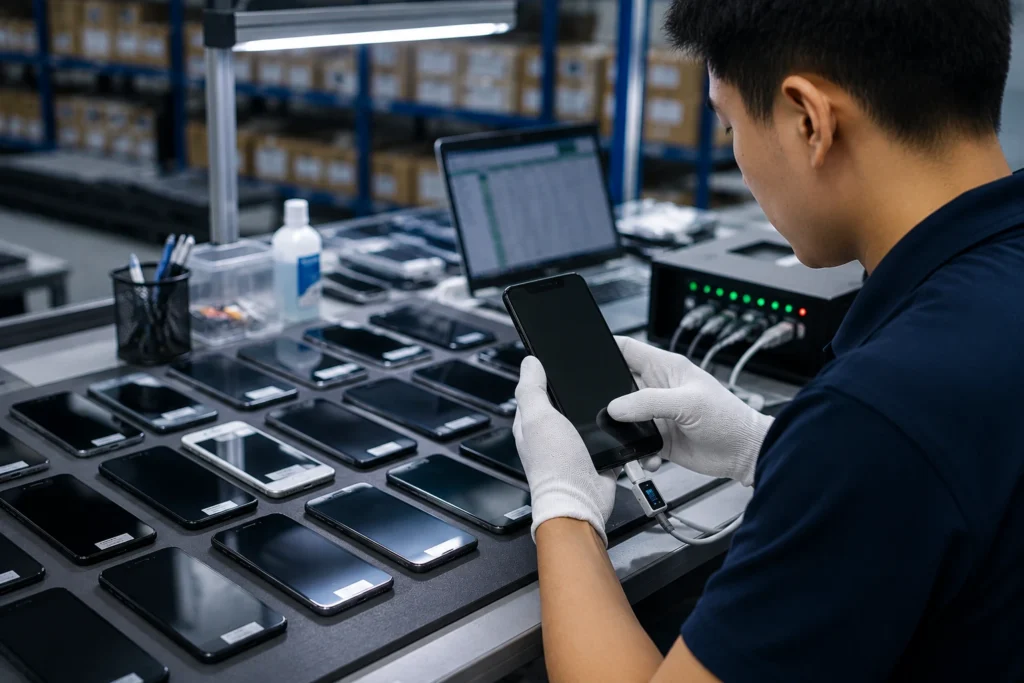
A thorough quality control process should extend well beyond confirming that a device powers on. At minimum, functional testing should cover touchscreen response, display uniformity, and dead-pixel detection; front and rear camera performance including flash and autofocus; speaker, microphone, and headphone jack function where applicable; Wi-Fi, Bluetooth, GPS, and cellular signal performance; charging port function together with wireless and fast-charge capability where relevant; button response and biometric sensors such as fingerprint or Face ID; and water damage indicator status alongside a check for internal corrosion.
Buyers should also confirm whether these tests are applied to every unit in a batch or only to a sampled percentage. For wholesale orders, testing across 100 percent of units, supported by a matching digital report, represents the standard worth insisting on.
Stock Availability, MOQ, Pricing, and Import Risk Reduction
Once a supplier’s quality control standard has been confirmed to meet the buyer’s requirements, commercial terms can be aligned so that pricing and order volumes match the intended resale plan without introducing additional risk. This includes requesting real-time stock availability broken down by model, grade, and QC-confirmed battery health range, and confirming the minimum order quantity per model as well as whether mixed-model orders are accepted above a combined threshold.
An itemized quotation should reference the QC level — Basic, Standard, or Advanced — applied to each batch, so that pricing can be compared on a like-for-like basis. Import risk can be reduced further by requesting a small sample order in the first instance and cross-checking the QC report against the physical units received, and, for higher-value shipments, by confirming whether cargo insurance is available and whether QC documentation accompanies the export paperwork.
Used Phone Quality Control Checklist
The table below summarises the points covered in this guide and can be used as a final review before a purchase order is approved.
| Checklist Item | Confirmed? |
| Written QC procedure document provided by supplier | ☐ |
| Sample QC report received matching your target model | ☐ |
| QC level (Basic/Standard/Advanced) confirmed and matched to price | ☐ |
| Minimum battery health percentage guaranteed in writing | ☐ |
| Full IMEI list provided and independently blacklist-checked | ☐ |
| Functional test list confirmed (screen, camera, ports, sensors, network) | ☐ |
| 100% unit testing confirmed, or sample percentage disclosed | ☐ |
| QC report format confirmed (per unit or per carton) | ☐ |
| Sample order completed and cross-checked against QC report | ☐ |
| Replacement/refund policy for failed QC units confirmed | ☐ |
Common Mistakes Buyers Make When Evaluating Used Phone QC
Trusting the Word “Tested” Without a Report
Many listings state simply that units are “100% tested,” without any supporting documentation. In the absence of a written report showing which tests were performed and what results they produced, this phrase functions as marketing language rather than a genuine quality guarantee. It is advisable to request the actual report format from a supplier before placing an order, rather than accepting the claim at face value.
Confusing Grading With Quality Control
Buyers sometimes assume that a cosmetic “Grade A” rating implies that a device is fully functional. As set out earlier in this guide, grading and quality control address different questions, and it is good practice to request both a grading sheet and a separate functional test report before finalizing an order.
Not Confirming Which QC Level a Quotation Reflects
Comparing prices across suppliers without first establishing whether each is quoting against Basic, Standard, or Advanced QC leads to comparisons that are not truly equivalent. A lower unit price tied to Basic QC may ultimately prove more costly once the effects of returns and functional failures are taken into account.
Skipping Independent IMEI Verification
Relying solely on a supplier’s assurance that IMEIs are “clean,” without independently verifying blacklist status, leaves buyers exposed to the risk of receiving stolen or locked devices that cannot be activated in their market. Independent verification, carried out before final payment, removes this risk at negligible cost.
Ordering at Full Volume Without a Sample Batch
Proceeding directly to a full container or pallet order, without first placing a small trial batch, removes the buyer’s only opportunity to confirm that a supplier’s QC reports genuinely reflect the physical condition of the units received. A modest sample order is a small cost relative to the risk it eliminates.
Choose Suppliers Who Document Their QC Process
A reliable used phone quality control checklist converts general quality claims into standards that can be verified. Suppliers who provide written QC procedures, sample reports, battery health data, and independent IMEI verification are demonstrating that their refurbished phone testing process can withstand scrutiny, which is precisely what a wholesale buyer requires before committing to volume. Applying the used phone inspection checklist set out in this guide allows buyers to compare suppliers fairly, reduce the incidence of returns, and build sourcing relationships founded on documented, repeatable used phone QC rather than on assurances alone.
INENG TECHNOLOGY CO., LIMITED applies a documented, multi-point QC process to every unit shipped, with battery health reporting, verified IMEI records, and per-unit test documentation available on request for wholesale orders.
Want to see our full QC process before you order?
Get QC Details — request sample test reports, battery health data, and IMEI verification records from INENG TECHNOLOGY CO., LIMITED today. Review real inspection reports to understand how every device is tested, graded, and verified before shipment. Discuss your quality requirements with our team and receive documentation tailored to your wholesale order. Contact us today to request a quotation, current inventory availability, and complete quality control documentation.
Frequently Asked Questions
What should a proper used phone quality control checklist include?
A complete used phone quality control checklist should include the IMEI, battery health percentage, and an itemized list of functional tests performed—covering the screen, cameras, ports, sensors, and network connectivity—together with the pass-or-fail result for each device, ideally recorded per unit.
How many test points should a refurbished phone testing process cover?
A professional refurbished phone testing process typically covers twenty or more test points, including the display, cameras, audio, connectivity, charging, sensors, and water damage indicators. A used phone inspection checklist covering fewer than ten test points generally indicates a more basic and less reliable testing standard.
Is a battery health guarantee standard in used phone QC?
Yes. Reputable suppliers performing used phone QC typically guarantee a minimum battery health percentage, commonly 85% or higher for Grade A and 80%+ for Grade B, for graded stock and can provide battery diagnostic reports to support this figure upon request.
Can I request QC reports for every unit in a bulk order?
Yes. For wholesale orders, it is reasonable to request per-unit reports generated during used phone QC, or at minimum per-carton reports referencing IMEI ranges, so the results can be verified against the physical shipment after delivery.
What is the difference between Standard and Advanced used phone QC?
Standard used phone QC typically covers ten to fifteen functional test points with a batch-level summary. Advanced used phone QC includes twenty or more test points, provides per-unit diagnostic reports, incorporates a comprehensive used phone inspection checklist, and includes full IMEI blacklist verification, making it the preferred choice for larger wholesale orders.
Should I still order a sample batch if the supplier provides QC reports?
Yes. Even when a supplier shares reports from their refurbished phone testing process, ordering a sample batch allows you to confirm that the physical condition and functionality of the devices match the documented results before placing a larger wholesale order.
How can import risk related to quality control be reduced?
Import risk can be significantly reduced by requesting a documented used phone quality control checklist, reviewing sample QC reports, performing independent IMEI verification, and placing a small trial order. Combining a thorough used phone inspection checklist with verified refurbished phone testing results provides greater confidence before committing to full-volume purchasing.